India’s Gen Z revolt did not stop at mocking Modi. It entered the home, broke the family relay through which Hindutva reproduced itself, and turned inherited obedience into open political defiance.
To understand the language of the Cockroach Janta Party (CJP), one must resist deciding in advance what kind of politics it represents. The movement has been described as ideologically incoherent, politically immature, covertly partisan or simply another eruption of digital anger. Such descriptions may eventually illuminate aspects of it. As starting points, however, they foreclose the object that requires attention: the political work being performed by the movement’s language.
To study a movement on its own terms does not mean accepting its self-description uncritically. It means reconstructing its political reason before imposing an external explanation upon it. The prior question is not whether the CJP already possesses an ideology in the recognisable form of a manifesto, doctrine or party line. It is how its language gathers dispersed experiences, converts humiliation into a shared interpretation and allows those addressed as isolated failures to recognise themselves as inhabitants of a common political condition.
The absence of formal doctrine is not the absence of ideological activity. A movement may produce an extensive interpretation of the world through names, jokes, insults, slogans, deliberate misspellings, songs, memes and bodily gestures before it formulates that interpretation as a programme. Ideology does not reside only in party texts. It is present in ordinary language: in the words through which authority names people, assigns social value and determines which grievances will count as political.
The significance of the CJP lies partly in this linguistic threshold. It has not merely placed another set of demands before the government. It has begun to unsettle the grammar through which the government, the BJP, the compliant media and the family had taught people to understand those demands.
From Insult to Assembly
V. N. Voloshinov provides an essential starting point. In Marxism and the Philosophy of Language, the word is not a neutral vessel carrying ideas formed elsewhere. The sign is itself a material site of ideological struggle. Differently situated speakers bring competing social accents to the same word, making its meaning impossible for any authority to secure finally.
“Cockroach” is an almost exemplary instance.
As an insult, it attempts to assign a social position. The cockroach is unwanted life: numerous, contaminating, furtive and difficult to eradicate. It inhabits the house without being acknowledged as one of its legitimate occupants. Applied to unemployed or protesting young people, the term does more than express contempt. It places them beneath the threshold of political consideration.
The word performs an ideological operation. It converts a social crisis into a problem of excessive population. Examination candidates, unemployed graduates and frustrated aspirants cease to appear as citizens with claims upon institutions. They become a swarm: too numerous, too persistent and too inconvenient to be answered individually.
But the sign does not remain where power places it. Once those named as cockroaches begin answering to the word collectively, its direction changes. What travelled vertically as degradation begins circulating laterally as recognition. The term retains the memory of contempt, but contempt is no longer its only political meaning. It becomes a point at which individuals discover that their apparently private failures belong to a common institutional condition.
The movement does not simply reply: “We are not cockroaches.”
It asks: “What if all the cockroaches come together?”
That is the more disruptive response. It refuses the requirement that the injured must first establish their respectability in the language of those who diminished them. The insult is not merely contradicted; it is reorganised. A sentence imposed upon isolated individuals becomes an invitation to assembly.
Judith Butler’s account of injurious speech helps explain this reversal. An injurious term attempts to fix its addressee in a subordinate position. But because its force depends upon repetition, it can be cited in another context and made to acquire effects that its original speaker neither authorised nor anticipated.
The CJP does not cancel the history of injury contained in “cockroach.” Its political act depends upon remembering that the word was meant to injure. Yet repetition removes the term from the exclusive custody of the injuring authority. Classification becomes identification; identification becomes assembly. The name intended to diminish political personhood begins to call a political subject into existence.
Ravish Kumar grasped the force of this reversal in his early reportage on the movement: young people who might ordinarily recoil from a cockroach had begun deliberately to name themselves as one. The abject creature of the social underside was becoming the bearer of a political claim.
The reclamation nevertheless contains a danger. An abject identity can become a prison. A community may seize the name imposed upon it while remaining confined within the imaginative universe of the power it opposes. The cockroach may signify endurance, but survival alone is not emancipation. Its immediate ideological force lies instead in refusing the authority that had presumed the right to determine who could name whom.
Contesting the Authorised Language of the Nation
James C. Scott’s distinction between public and hidden transcripts clarifies another aspect of the movement. Relations of domination generally produce a restrained public language and a more unruly discourse outside the immediate presence of authority. The latter contains ridicule, resentment, obscenity and fantasies of reversal that cannot safely be expressed in the official encounter.
The CJP marks the movement of this less supervised language into mass public visibility. Its abusive nicknames, jokes, altered slogans and mockery of political solemnity were not invented at Jantar Mantar. They had been forming through private conversations, family quarrels, stand-up comedy, digital subcultures and the semi-public spaces of online life.
At the protest, the hidden transcript stepped onto the street.
The conflict becomes particularly important in relation to Hindi. As Alok Rai has shown, Hindi is not a politically innocent or naturally unified language. Its modern authority was produced through purification, institutionalisation and separation: Hindi from Urdu, Sanskritised vocabulary from the mixed resources of Hindustani, and an authorised national register from the heterogeneous speech of actual populations.
Rai’s history helps explain why the ceremonially Sanskritised Hindi of the contemporary state cannot be treated as merely a formal version of ordinary speech. It inherits a longer politics of purification and belonging. It tells the nation not only what may be said but what the nation should sound like.
Under the BJP, this inheritance has been adapted to a governmental vocabulary of civilisational renewal: “bhavya Bharat, rashtra chetna, sanskriti, virasat, kartavya, amrit kaal.” The government speaks in this language; the party repeats it; compliant television channels circulate the same words. Government, party and media do not merely share arguments. They reproduce a common description of reality.
This vocabulary raises political speech above the disorder of ordinary experience. The state appears as the bearer of historical destiny, while paper leaks, unemployment, recruitment delays and institutional opacity are reduced to temporary disturbances within an otherwise magnificent national ascent.
Repetition makes this description appear natural. Alternative accounts can then be dismissed as negativity, disloyalty or noise. The state speaks in the idiom of destiny; the unemployed candidate is left with the idiom of personal failure.
The CJP vernacular interrupts this alignment. Its Hindi is mixed, improvised and deliberately impure. It moves between Hindi and English, bureaucratic terminology and street abuse, constitutional language and internet slang. It does not attempt to defeat the state by imitating the state’s solemnity. It makes political intelligence audible in forms the establishment has trained itself not to recognise.
From Noise to Political Speech
Jacques Rancière’s distinction between speech and noise is particularly useful here. Political order does not merely distribute resources, offices and institutional authority. It distributes audibility. It determines whose utterances count as speech and whose are registered merely as disturbance, vulgarity or emotional excess. Politics occurs when those denied a recognised part interrupt that distribution and demonstrate their capacity to speak about the common world.
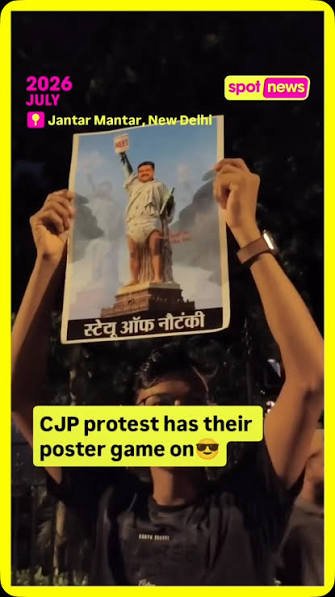
The CJP vernacular stages precisely this dispute. Its memes, jokes, code-switching, obscenities and grammatical irregularities can easily be dismissed as evidence of political unseriousness. But such a dismissal may reveal less about the movement than about the conventions through which established politics decides what intelligence should sound like.
One placard asks:
“अच्छे दिन कब लीक होंगे?”
When will the good days leak?
The line compresses an entire political argument into a verbal substitution. Achhe din, the promise around which the Modi government once organised national expectation, is placed alongside the recurrent experience of examination papers being leaked. What should circulate—the benefits of national development—does not. What should remain secure—the examination paper—does.
The slogan forces two otherwise segregated realities into the same sentence. Official discourse speaks of national ascent, opportunity and youth power. The candidate encounters compromised examinations, cancelled recruitment and institutional delay. The verb “leak” makes the distance between promise and experience available to laughter.
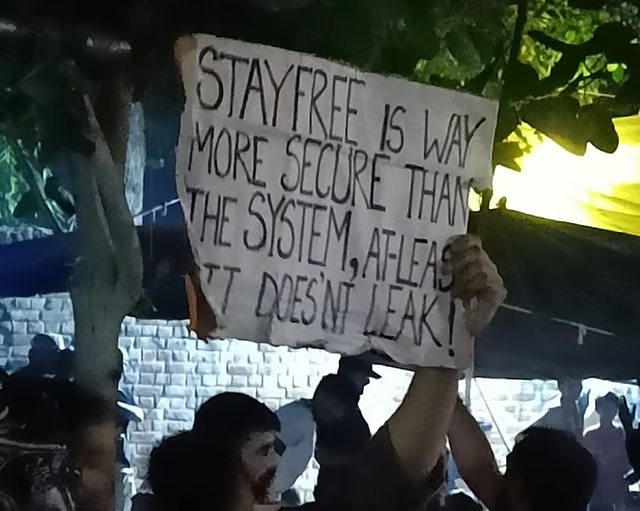
Another slogan makes the argument through bodily indignity:
“डायपर भी लीक नहीं करता, मगर पेपर लीक हो जाता है।”
Even a diaper does not leak, but an examination paper does.
The vulgarity is exact rather than gratuitous. It lowers the elevated language of governance to an elementary test of institutional competence. The state may invoke civilisation, technological modernity and global power, but it cannot protect an examination paper with the reliability expected of a disposable consumer product.
This is ideological desacralisation: political grandeur brought into contact with the material evidence it has attempted to outrun.
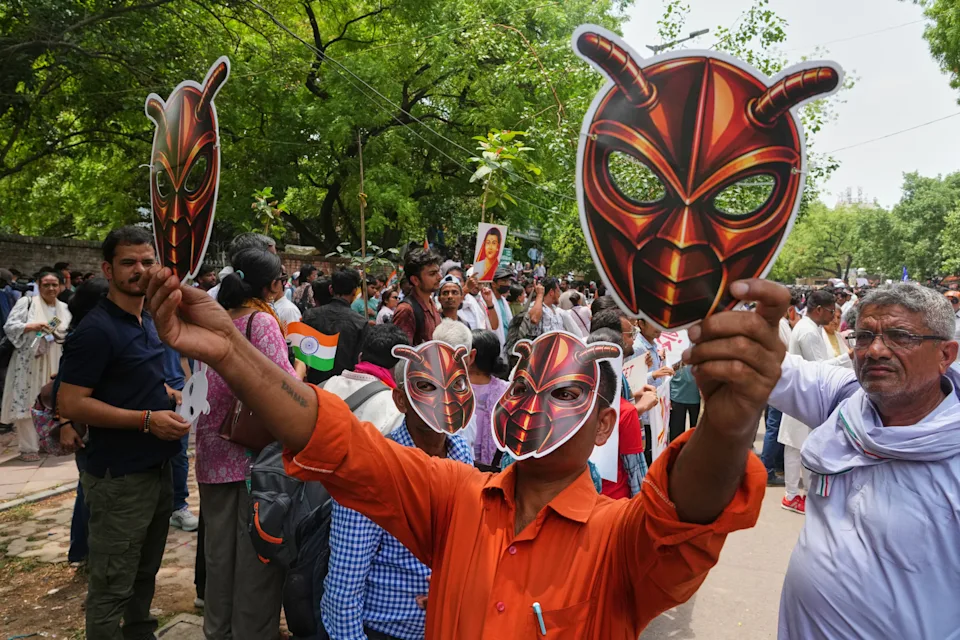
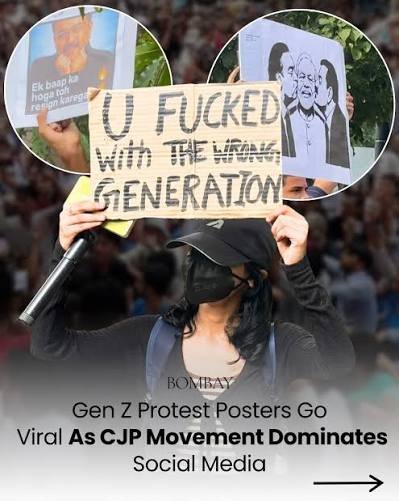
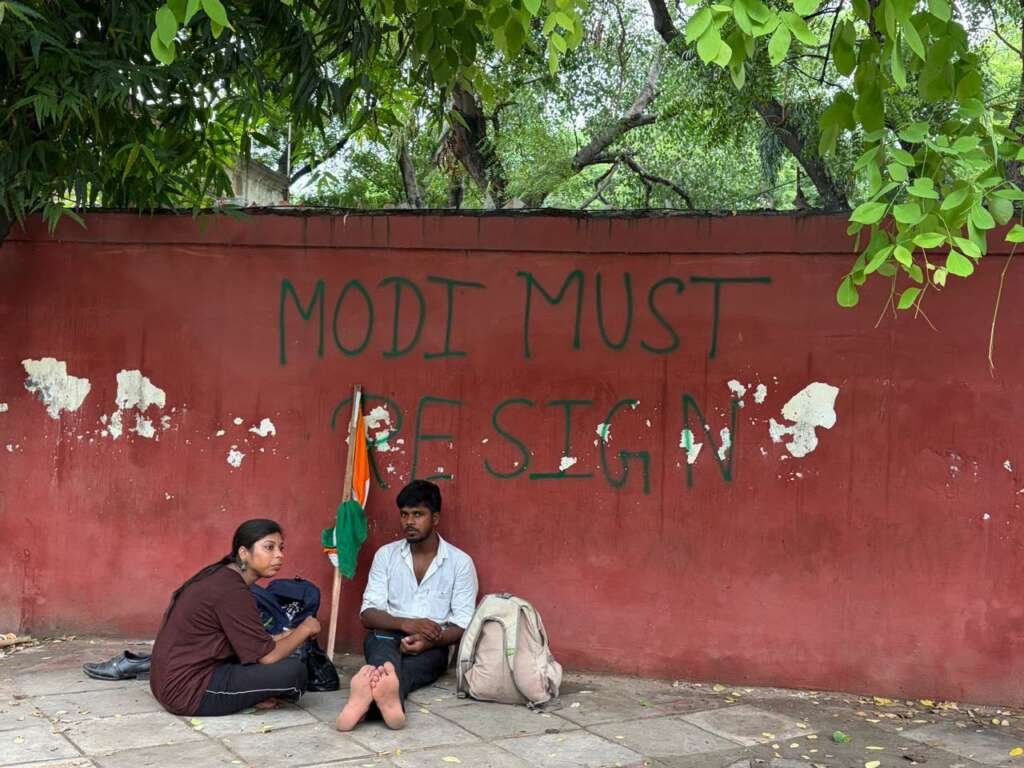
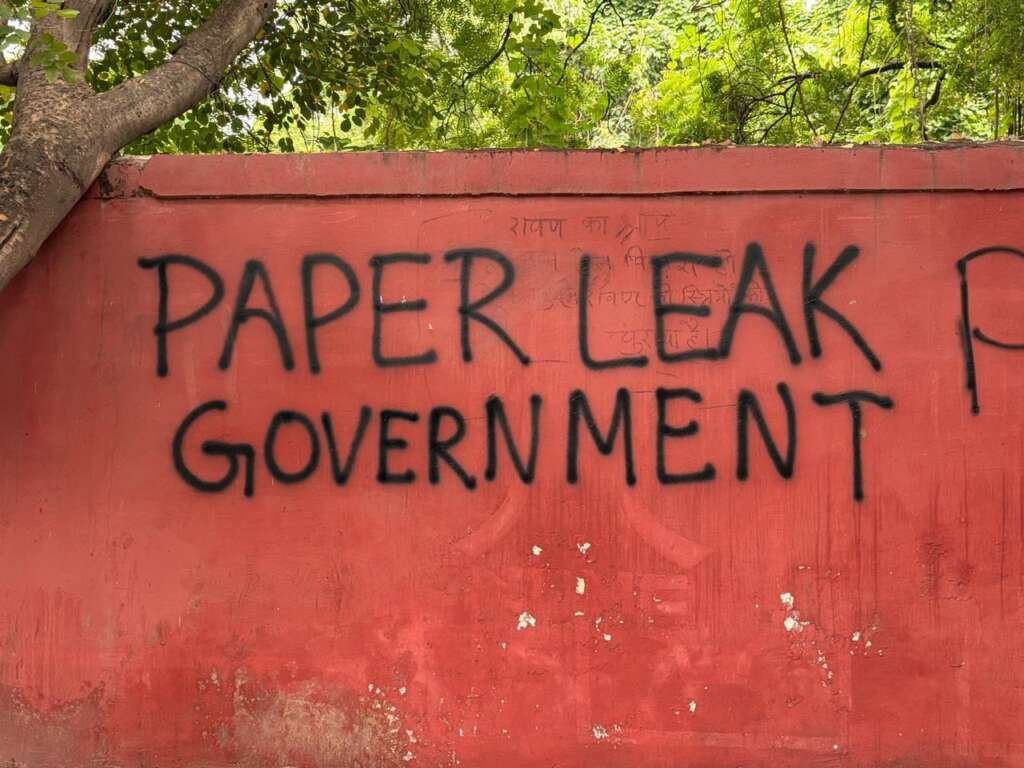
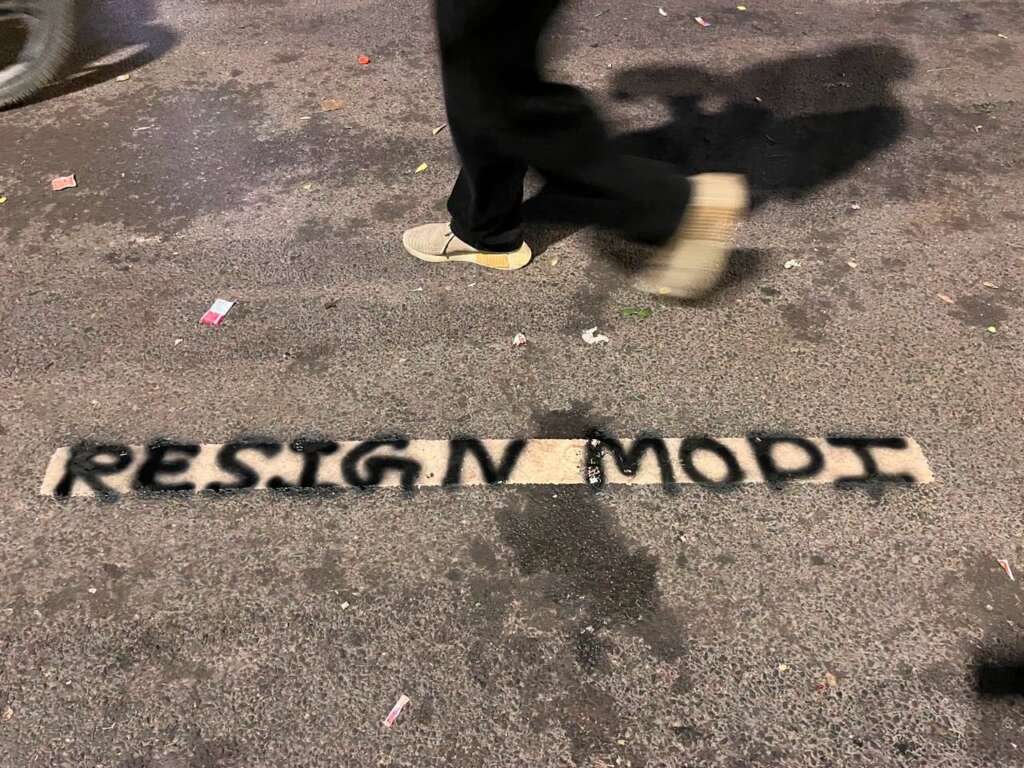
The same operation appeared across the protest walls. “PAPER LEAK GOVERNMENT” condensed years of examination scandals and administrative impunity. “PM IS COMPROMISED” turned the vocabulary of national security upon the sovereign himself. “चंदा चोर BJP” and “वोट चोर MODI” stripped official grandeur down to the language of theft. “RESIGN MODI” dispensed with reverence and circumlocution. “U FUCKED WITH THE WRONG GENERATION” was cruder, but its crudity was itself part of the claim: this generation would not submit its anger for grammatical correction by the political class.
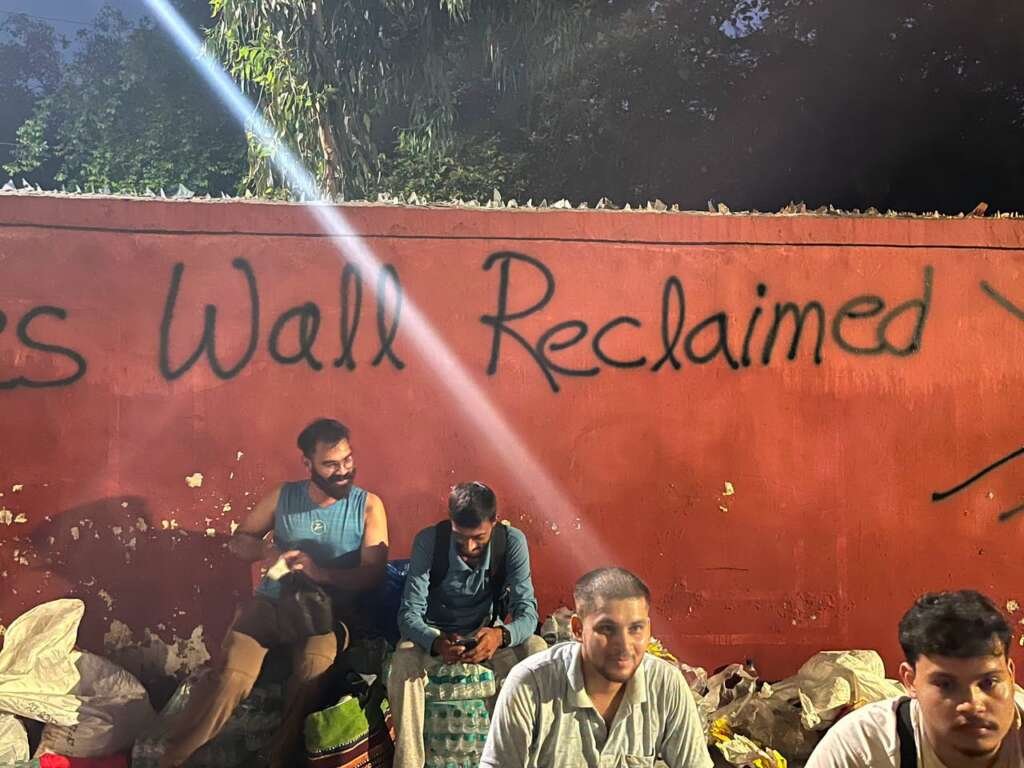
The authorities whitewashed the wall. The slogans returned.
That brief sequence offered a miniature of the larger confrontation. Power retained the ability to erase an inscription, but it no longer enjoyed a monopoly over the language in which political reality could be named. The wall became a palimpsest of command and refusal: inscription, deletion, return. Whitewashing could restore the surface. It could not restore obedience.
A Constituency Formed in the Speaking
The CJP vernacular does not merely express an already unified Gen Z constituency. It helps bring that constituency into being.
Lisa Mitchell’s account of the historical production of linguistic attachment offers a useful methodological caution: a linguistic constituency should not be assumed to exist naturally before its public articulation. Languages become objects of emotion, identification and political mobilisation through institutions, practices and repeated acts of recognition.
By extension, participants in the CJP do not first become one people and then discover a language adequate to their unity. Through jokes, slogans, clips and repeated acts of naming, they begin to recognise themselves as contemporaries inhabiting related conditions.
Their solidarity does not depend upon linguistic sameness. It develops through a shared relationship to institutional time: the examination postponed, the result withheld, the recruitment delayed, the age limit crossed, the future repeatedly promised and continuously withdrawn.
The movement’s language gives this temporal condition a common emotional form. It turns shame into anger and apparent individual inadequacy into institutional accusation. It takes waiting, debt, coaching classes, repeated examinations and delayed adulthood and gives them public names.
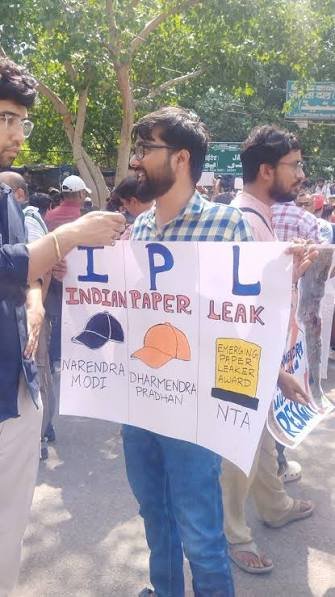
The slogan comparing the education minister to a mountain offers a clear example:
“धर्मेंद्र प्रधान पहाड़ हैं तो हम भी दशरथ मांझी हैं। जब तक तोड़ेंगे नहीं, तब तक छोड़ेंगे नहीं।”
If Dharmendra Pradhan is a mountain, we too are Dashrath Manjhi. We will not stop until we break it.
The metaphor draws upon the widely circulating story of Manjhi cutting a path through a mountain. But it does more than celebrate perseverance. It transforms a minister into an obstruction and candidates into collective agents capable of wearing down what appears immovable.
The slogan does not ask the state to clear the path. It imagines the public cutting through the structure that blocks it.
The constituency is formed in the speaking. Examination candidates cease to appear as isolated aspirants competing for scarce positions. They begin to understand themselves as citizens subjected to a common institutional betrayal. Language converts a queue into a public, delay into dispossession and frustration into accusation.
Mockery as a Democratic Faculty
Modi’s late-night, selfie-style appearance on Instagram was ripped apart almost immediately by Gen Z. The performance was intended as a direct address to protesting students; instead, its front-camera intimacy, timing and visual awkwardness became objects of widespread parody.
Mockery became a democratic faculty: a means of stripping patriarchal power of its inherited solemnity.
What made the moment politically exhilarating was not merely the spectacle of the supreme patriarch appearing unsettled before his own camera. It was the collective refusal to grant power the dignity it continued to claim for itself. Memes, jokes, altered slogans and merciless mimicry reduced the grand custodians of the nation to nervous men defending what increasingly resembled a private estate.
Ridicule here was not an escape from politics. It had become one of politics’ instruments. A generation raised beneath the suffocating earnestness of Hindutva—its invocations of sacrifice, civilisational injury, masculine resolve and national destiny—had discovered that authority could be weakened by making it absurd.
The patriarch depends not only upon obedience but upon atmosphere: the reverential silence around his speech, the ceremonial gravity of his image and the expectation that his presence must suspend ordinary judgement. Once that atmosphere is punctured, the figure projected as omnipotent begins to appear anxious, vain and vulnerable.
The memes did not offer a rival doctrine in the conventional sense. They attacked the regime’s control over tone. For years, power had decided which subjects required solemnity, which leaders deserved reverence, which historical wounds must be endlessly reopened and which contemporary sufferings could be ignored. Gen Z broke that tonal discipline. It answered the monumental with the ridiculous, the sermon with the remix and the carefully managed image with the freeze-frame and cutting caption.
Its refusal was linguistic before it became programmatic.
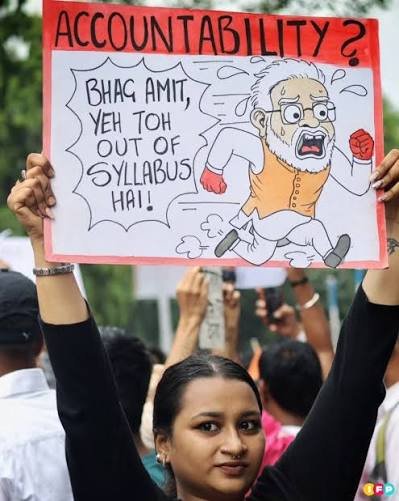
“Out of syllabus” captured this predicament precisely. In student speech, it is the familiar complaint made when an examination poses a question for which the official curriculum has offered no preparation. At Jantar Mantar, it became an account of the regime’s political bewilderment.
Gen Z itself was out of syllabus: politically formed under Modi, yet refusing the responses for which the Modi system had trained it.
The regime knew how to confront an opposition party, a trade union, an ideological cadre or a recognisable student organisation. It possessed a ready vocabulary for each: anti-national, foreign-funded, urban Naxal, dynastic, corrupt. But these protesters appeared in forms that slipped past such classifications. Their slogans could be serious and profane in the same breath. They could invoke constitutional accountability, examination fraud and unemployment, then turn patriarchal authority into an object of collective laughter.
The government’s difficulty lay not only in suppressing their claims. It lay in finding a language capable of containing them.
The Family as the Relay of Orthodoxy
What the movement brought into view, however, was not simply a generational disagreement. It exposed a rupture within the most intimate institution through which political orthodoxy had been reproduced: the family.
For more than a decade, the BJP-RSS project exercised power not only through elections, party networks, television studios, university appointments and social-media machinery. Its more durable achievement was linguistic. It reorganised the vocabulary through which millions of Indians interpreted politics, belonging, injury, aspiration and dissent.
Words such as nation, security, development, sacrifice, pride, loyalty and civilisation were folded into a majoritarian grammar. To be national increasingly meant accepting one authorised account of the nation. To question authority was to weaken the country. To demand accountability was to assist its enemies. To speak of unemployment, inequality or institutional failure was to be told that larger civilisational battles were at stake.
This language did not remain at the level of official propaganda. It entered the household.
What Ravish Kumar termed “WhatsApp University” and “Godi Media” became two mutually reinforcing institutions of everyday indoctrination. The day began with the apparently innocuous ritual of the WhatsApp greeting: religious imagery, civilisational pride, fabricated history, moral instruction and Hindutva virtue-signalling passed from one family group to another. These messages entered neighbourhood associations, alumni circles, professional networks and extended kinships, acquiring authority through repetition and the intimacy of the sender.
By evening, the television channels supplied the official chorus. What arrived in the morning as familial wisdom returned at night as national truth.
The messages were persuasive not necessarily because they were credible, but because they arrived through trusted relations. The lie came bearing the face of an uncle, a parent, an elder sibling or an old school friend. Its authority was borrowed from affection. What television propaganda declared publicly had already been softened and domesticated through networks in which disagreement carried an emotional cost.
The family did not merely receive propaganda. It translated propaganda into obligation.
Ideology circulated as concern, habit, advice and inherited wisdom. Parents did not need to speak like party functionaries. The structure was reproduced whenever a young person was told that criticism of Modi was criticism of India, that religious pride mattered more than material hardship, that protest was disorder, or that the nation’s enemies were responsible for suffering produced by the state itself.
Hindutva’s power lay precisely in becoming less visible as ideology. It presented itself as the natural language of faith, family, patriotism and cultural self-respect. Political propositions acquired the force of moral commands. Obedience to elders and obedience to the nation were made to reinforce one another.
A young person who questioned the BJP could therefore be made to feel that they were not simply expressing a different political judgement. They were insulting their parents, rejecting tradition, betraying their community or placing themselves outside the emotional boundaries of the nation.
When the Relay Breaks
Across videos circulating around the movement, young men and women spoke of defying parents, resisting filial pressure and refusing inherited BJP-RSS certainties. These were not theatrical declarations made without consequence. They carried the possibility of estrangement, economic precarity and a future stripped of familial protection.
Precisely for that reason, they marked a decisive political threshold.
The authority being challenged was no longer only that of the state. It was the everyday authority through which ideology had entered the home, acquired the force of duty and mistaken obedience for love. Hindutva’s success had depended upon this intimacy. To question the political message was also to question the person who sent it; to reject the ideology could appear as a rejection of the family itself.
The videos therefore recorded more than domestic quarrels. They showed the relay breaking down. A son refused to inherit the father’s political fear. A daughter rejected the demand that filial loyalty include reverence for a leader. Young people began separating care from control, inheritance from truth and family belonging from political submission.
Their defiance was directed at the point where ideology had been most successfully naturalised—where it no longer appeared as ideology at all, but as common sense, family wisdom and moral duty.
This is a difficult and often painful form of emancipation. Public dissent may invite police repression; domestic dissent brings emotional accusation. The young person can be called naive, manipulated, disloyal, anti-national or ungrateful. Approval can be withdrawn. Financial dependence can be used as discipline. The possibility of abandonment can hover behind what appears to outsiders as an ordinary family argument.
But every such confrontation weakens the assumption that political identity must pass intact from one generation to the next.
The significance of these conflicts lies in their multiplicity. An argument between one daughter and her father may appear private. A son’s refusal to repeat the politics of his household may be dismissed as adolescent rebellion. But when comparable confrontations occur across thousands of homes, they constitute a dispersed ideological rebellion.
The street does not create this rupture from nothing. It gathers it, gives it visibility and allows young people to recognise that their private disagreements belong to a wider transformation.
The mass protest is also the public convergence of innumerable acts of domestic and linguistic disobedience.
From Grievance to Claim
This rupture changes the emotional grammar of protest. The young do not present themselves merely as scarred subjects asking to be heard. They speak as claimants.
Victimhood describes what has been done to them. Claim-making declares what is owed to them.
A cry of victimhood asks power to recognise suffering. A political claim questions power’s right to continue as it has.
The student who says, “My examination was compromised,” may be treated as an unfortunate individual requiring administrative redress. The student who says, “You have destroyed the institutional basis on which an entire generation was asked to build its future,” identifies a structure of rule. The first statement can be absorbed by procedure. The second places the government itself under examination.
Young people no longer describe themselves only as candidates, aspirants, unemployed graduates or victims of paper leaks. They speak as citizens whose time has been appropriated and whose futures have been politically foreclosed.
They demand not sympathy but jawabdehi—accountability.
The regime calls protest disorder; the students call it democratic claim-making. The regime calls obedience patriotism; the students make accountability a patriotic demand. The regime describes examination scandals as technical irregularities; the students name them as theft—the theft of time, labour, aspiration and future. The regime treats unemployment as an individual failure or temporary difficulty; the students identify it as a structural political condition. Police violence appears in the official vocabulary as the maintenance of order; the protesters expose it as punishment for demanding an answer.
This conflict over language is not secondary to politics. It is politics.
Every durable ideology seeks to determine which grievances may be spoken, which terms are available to describe them and which identities can legitimately enter public life. Hindutva made one family of injuries overwhelmingly audible—civilisational insult, religious threat, historical humiliation—while rendering other injuries private, shameful or politically insignificant.
Unemployment became personal inadequacy. Examination failure became bad luck. Economic precarity became a test of endurance. Institutional collapse became an inconvenience. The young person was taught to absorb these failures individually while expressing collective anger primarily through religious identity.
The emerging student politics reverses that operation. It converts personal frustration into structural accusation. It gathers delayed examinations, failed recruitment, family debt and suspended adulthood into a common political grammar. Economic suffering is reattached to political responsibility.
Rewriting the Political Sentence
Young people are rejecting the words in which they were instructed to understand the nation. They cease to call silence responsibility, submission discipline, humiliation sacrifice, propaganda history or majoritarian dominance national unity.
Another vocabulary begins to emerge: dignity, work, fairness, institutional integrity, equal citizenship, accountability and future. These words are not new. What is new is their arrangement and their source of authority: the examination hall, the coaching centre, the university, the unemployment queue, the family debt and the years spent waiting for public institutions to function.
This vernacular contests Hindutva not merely by opposing its conclusions but by refusing its premises. It rejects the proposition that religious identity must remain the primary language of political belonging. It refuses the displacement of material demands by symbolic victories. It refuses a hierarchy in which the state speaks and citizens receive, elders declare and the young obey, leaders embody the nation and protesters are placed outside it.
The new political energy emerges from this refusal of inherited syntax.
The young no longer accept a political sentence in which the government is always the subject, the nation the sacred object and the citizen merely the obedient recipient of history. They rewrite the sentence. The citizen becomes the subject. The government becomes answerable. The nation ceases to be the possession of one ideology and becomes a field in which competing claims must be heard.
The mockery of the patriarch and the defiance of the parent are therefore not separate phenomena. They belong to the same democratic rupture. In public, Gen Z laughs at the figure who demands national reverence. In private, it challenges the familial authority that taught such reverence as duty. One strips power of solemnity; the other interrupts its inheritance.
This is why the rupture within BJP-RSS-supporting families may prove more consequential than an immediate fluctuation in electoral opinion. A political movement can withstand criticism from opponents it already knows how to name. It becomes more vulnerable when its language no longer reproduces itself naturally among the children of its own supporters.
The crisis begins when propaganda must explain itself where it once passed without challenge. It deepens when the dinner table becomes a site of argument rather than transmission. It becomes politically dangerous when the young discover that the language they inherited cannot describe the lives they are actually living.
They are not merely saying that the promises of the regime remain unfulfilled. They are saying that its entire language of promise has become unbelievable. They no longer consent to a politics offering flags in place of futures, pride in place of employment and obedience in place of citizenship.
They are not asking to be incorporated into the old ideological grammar. They are producing another one.
That is what makes them genuinely “out of syllabus.” The regime had prepared itself against opposition. It had not prepared itself for a generation withdrawing recognition from its language, laughing at its patriarchs and interrupting the reproduction of its politics within the family itself.