
Tabish Khair’s Gothic reckoning: a refugee returns as a shadow to haunt the ruins of liberal orthodoxy.
A review of Tabish Khair, Drown All the Refugees (HarperCollins India, 2026)1
The loudest sentence in Tabish Khair’s new novel is its title. It is designed to offend, and it does. The quieter sentence comes a few pages later: “the right to move freely is secondary to the right to stay free” (p. 9). I found myself returning to this, perhaps because it puts the question of the refugee somewhere other than where liberal concern usually finds it. We meet the refugee after the home has been lost, in a boat or at a fence, inside the camp, before a tribunal. By then departure has become the fact that organises everything. Khair moves backwards. Who destroyed the possibility of remaining? Who made home uninhabitable and then treated flight as the offence? What, more painfully, happens when someone appears to come home and almost none of the person who left appears to come back with him?
Perhaps I kept returning to that sentence because it exposed how often concern begins only after the decisive violence—the destruction of the possibility of remaining—has already taken place.
I read the book between London and Geneva. That fact entered my reading whether I wanted it to or not. In both cities, refugees were present in political speech as pressure, cost, risk, nuisance; actual people appeared less often. The public mood seemed no less hostile than the politics conducted in its name. I could close the book in a railway carriage and hear its categories repeated in a tidier language. I was not reading from outside the liberal world Khair arraigns. I live inside its assurances, and I benefit from the passport, education and professional ease that make crossing a border an ordinary act for some of us. This made the novel’s accusation harder to displace, though it did not require me to surrender judgment to it.

Khair’s refugees move through the ruins of the global liberal orthodoxy. Even the Refugee Convention now survives rather like the refugee it was created to protect: admitted in principle, resisted in practice, never secure in its right to remain.
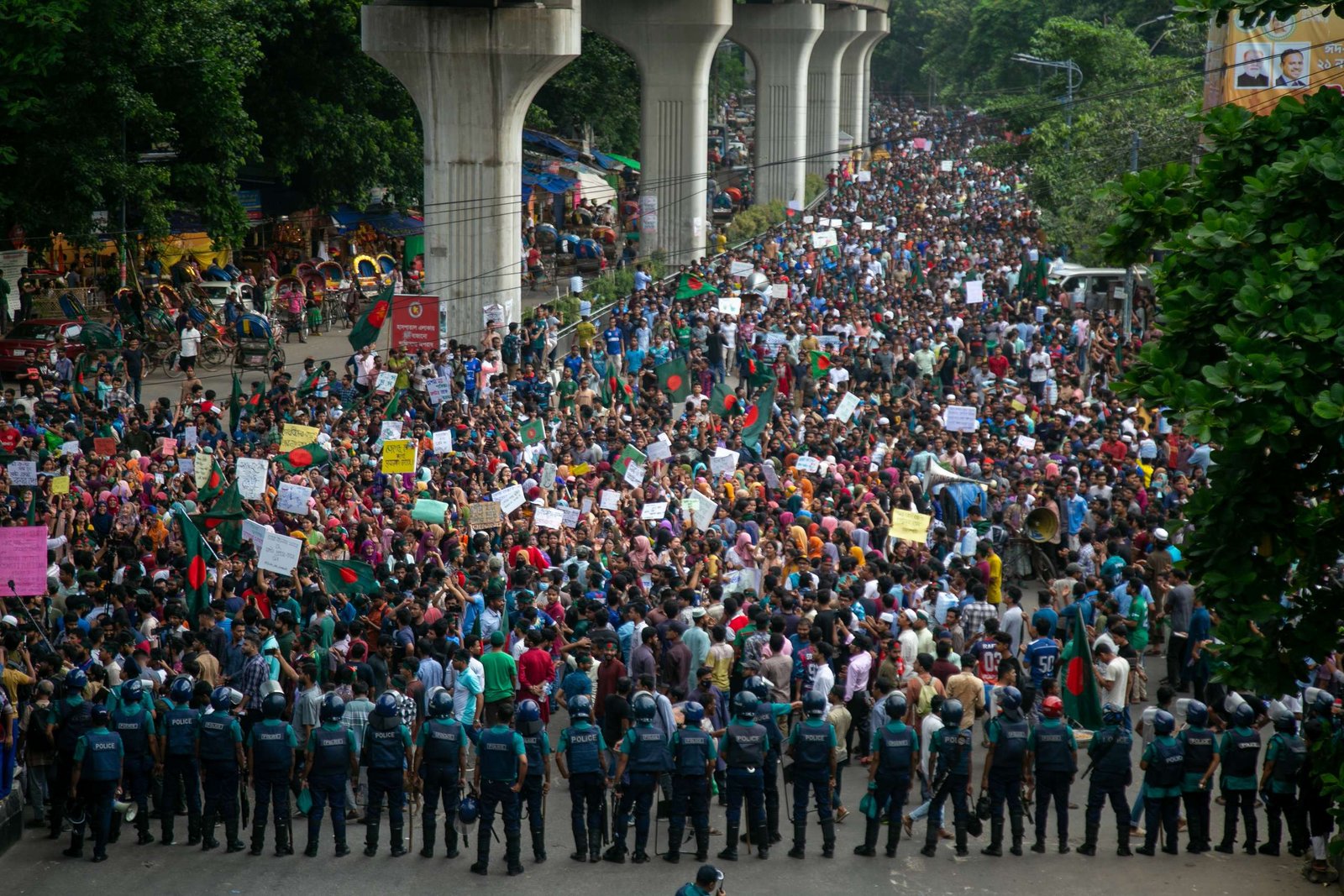
The question has acquired a terrible nearness. The Refugee Convention turned seventy-five on 28 July 2026. Two days later, a mass crossing into the Spanish enclave of Ceuta left scores of people drowned or crushed at the border. By 21 August, bodies were being lowered into graves marked with numbered stones. Most had not been identified.2 Enough identity for an administrative procedure; too little for a family to mourn a named person. Khair could not have written the incident into the novel. It nevertheless seems to have walked out of his pages.

The preface stands some years after October 2023, in a future that is scarcely futuristic: Trump Revivalists speak of an “Indian invasion”, India is the world’s third-largest economy, and Gaza remains a catastrophe everyone has seen and few with power have been willing to stop. Khair gives us our present after a little more habituation.
At a literary gathering on St Martin, an iPhone carrying an image of a refugee boat lights the faces of writers gathered around it. The people in the boat remain elsewhere. Their danger becomes illumination upon the spectators. They can condemn governments, finish their drinks, return to their rooms. The image is visible. Visibility has already failed.
The unnamed narrator, a middle-aged Indian writer in a language with almost no standing in the Anglophone market, suddenly shouts “Drown all the refugees” at a famous American writer. The American leaves in disgust. The book becomes a defence addressed to him as “m’lord”: confession, legal brief and Gothic testimony, with the narrator unsure whether he wants acquittal, understanding or the right to go on speaking after saying the unforgivable thing.
Two absent men give the defence its shape. Pedro, the son of Maria—the narrator’s childhood nurse and his family’s housekeeper—grew up beside him on the family plantation in northeastern India, close enough to be called a brother, never equal enough for the word to be innocent. After his hopes of becoming a footballer fail, Pedro leaves through traffickers; what comes home may be his ghost, his shadow or the damaged remainder of a life. Abdul, the narrator’s dead lover, was born to Palestinian parents displaced after 1967, grew up in Afghanistan and later lived in India. Pedro supplies the book’s central mystery of departure and return; Abdul supplies the grief from which the narrator speaks.
“M’lord” is funny at first: servile, insolent, sore. It turns the American writer into a court and international literary life into a jurisdiction. The joke gradually hardens. The American remains schematic, more office than person—liberal, celebrated, morally correct, accustomed to welcoming difference after its difficult parts have been translated away. This serves a function, though it makes the case against him too easy; the narrator’s contempt sometimes knows the verdict before the evidence has been heard.
The narrator is no innocent outside the world he accuses. His family’s plantation in northeastern India is a residue of British extraction, acquired by Indians who inherited the earlier owners’ distances and cruelties. His father spoke to workers in local dialects, bullied them in the same languages, then banished those languages from the dining table. The narrator knows linguistic marginality and sexual estrangement; he also knows the mobility conferred by a passport, an American education, an agent and class. A morally clean narrator would have damaged the book.

Who has the right to move, remain and return?
Khair gives the narrator’s defence its first human test in Maria—Pedro’s mother, the narrator’s childhood nurse and the family’s housekeeper—bringing him coffee after 7 October 2023. “I present to you, m’lord, exhibit number one in my defence: Maria” (p. 14). The exhibit soon expands to include Pedro, the football field and the narrator’s father’s vandalised car. This is where Khair’s argument about remaining acquires a life rather than a slogan.
Khair lets this unease enter the syntax. The narrator interrupts his description of Maria over the colour of her face, resumes with her work-coarsened hands and clothes, then moves into her family’s conversion and the plantation’s history. The sentence cannot complete a portrait without disclosing the gaze behind it. Such fretfulness becomes mannered elsewhere; here it displays the habits of looking that class has given him.
His first formulation soon proves inadequate. The exhibit becomes “Maria, Pedro, the football field, my father’s vandalized car”. The correction acknowledges that Maria cannot be lifted from the relations that made and diminished her life, though the enlarged exhibit still belongs to his defence.
That childhood fraternity is tested by the lives available to the two boys. They exchange footballs, plans and photographs of famous players. The narrator proceeds to an American university while Pedro’s hopes narrow into coaching local boys. Returning after his father’s death, he belatedly discovers that Pedro has left through traffickers. Maria’s self-respect had kept her from appealing to the employer’s son: if he knew and had said nothing, she assumed, he could not help. The rebuke is quiet and deserved.
Pedro’s departure does not initially sit easily within the Convention’s definition of a refugee.2 Economic exhaustion, regional abandonment and criminalised passage press him outward. Khair will push the word refugee backwards, towards the destruction of a person’s capacity to remain.
Pedro appears to return. The narrative has already promised that he will, and its retrospective hitch—“I didn’t know it then”—lets the manuscript know what the remembered man does not. The novel withholds what kind of return this is. Pedro’s body is said to be elsewhere; he appears intermittently, cannot bear sunlight and remembers his journey in broken images. What comes home is recognisable and depleted, the outline of the boy and man Maria loved. The return is asserted within the story and kept ontologically unsettled around it.
Maria believes that she can join Pedro’s shadow to lost substance. Her wish to make her son whole eventually requires another body, and begins to resemble the system that destroyed him. The right to stay free has widened into the right to return as oneself—and not at the cost of somebody else’s life.
The novel’s supernatural logic is present in the narrator’s memory of childhood magnets. After describing Abdul’s death, he rejects the idea of an invisible third object joining them. What existed was “a relationship between them” (p. 26): attraction and repulsion produced by the same bodies differently aligned. He remains an agnostic inside the haunted house. For him, ghostliness belongs to relations damaged beyond ordinary sight. A person deprived of the conditions of remaining becomes first a category, then a case, and finally a shadow. Khair is strongest when objects and altered bodies bear this argument; elsewhere the polemicist follows too quickly to secure their meaning.

It is tempting to say that Khair has now written a novel about refugees because refugees have become the central political figures of our century. That would miss how long he has been approaching this book. An Indian novelist and critic long based in Denmark, where he teaches English at Aarhus University, Khair has spent three decades examining the unequal traffic between languages, classes and countries. His oeuvre constitutes “an archive of words imposed upon people before they speak”: babu, thug, Islamist, jihadi, migrant, refugee. These nouns are never only descriptions. They decide whose account will be believed, whose travel will appear suspicious, whose grief needs translation, whose body can become evidence.
The Bus Stopped used a private bus between Gaya and Phansa to place passengers divided by caste, class, gender, religion and money on the same road without pretending that proximity made them equal. In Other Routes, the anthology Khair co-edited, fifteen centuries of African and Asian journeys challenged the conceit that Europeans travelled while the rest of the world waited to be described.3 The common vehicle has fractured in the new novel: writers fly to St Martin, Abdul crosses countries as refuge repeatedly collapses, and Pedro’s passage is criminalised. Who is allowed to appear as a traveller, and who is processed as a migrant, soldier, trespasser or refugee?
Unlike The Bus Stopped, which distributes knowledge across a cast, the new novel compresses its several worlds into one compromised voice, advancing by qualification, self-correction, etymological play and belated connection. Confession becomes a legal plea; a road notebook opens into a ghost story; political essay gives way to interrogation. The shift from restless retrospection to Pedro’s clipped answers makes style carry the central ethical pressure: who controls the form in which another person’s suffering can be heard?
Pedro’s story gives way for a time to an old Moleskine from the narrator’s final year in America. He had planned his own On the Road or Travels with Charley, written in his Indian language, before ambition and the journey both petered out. He translates and “embroiders” the abandoned diary for “m’lord” (p. 114). Translation is already unreliable, and he tells us so.
His second-hand Mustang breaks down in the American South near a route associated with the Trail of Tears. He has pasted American flags on the car and wears an American-looking hat, camouflage for the complexion that passing drivers might read as “‘Ayrab’, Mexican, Caribbean” or the other kind of Indian. The famous American road, so often made into a line of self-invention, becomes a place where freedom depends upon whether a stranger can read your face without becoming afraid of it.
Bob, the Black truck driver who stops, has named his vehicle “Back-Dad”—Baghdad (p. 117). The army enabled him to buy it and escape his father’s dependence upon white employers. He acquired one precarious independence by shooting at brown men in Iraq: racial capitalism, imperial war and private aspiration fitted into the cab of a truck. Bob’s rendered dialect approaches caricature, a problem the narrator’s admission that he is translating cannot dissolve.
Abdul, the narrator’s dead lover, gives the novel another and historically distinct itinerary of displacement. Born to Palestinian parents displaced after 1967, he grows up in Afghanistan, becomes involved with a communist student organisation, leaves amid the ascendancy of the Mujahideen and the Taliban, and eventually teaches anthropology in India. Palestinian by parentage, formed in Afghanistan, later resident in India, Muslim without doctrinal submission, queer: his life crosses categories faster than they can contain him. He is not simply Pedro’s counterpart. Pedro leaves through traffickers after local possibilities close around him; Abdul’s life passes through successive political displacements. The novel brings them into relation without making their routes interchangeable.
Abdul is the book’s most fully heard absence. His intimacy with the narrator exists in words, jokes, corrections and false etymologies. He plays with the Arabic safar, travel, and sifr, zero or emptiness, wondering whether “suffer” belongs somewhere in the same wandering family. It does not, etymologically. The emotional intelligence of the mistake survives its falsity. After Abdul dies, the narrator finds another root for suffering: bearing, carrying, bringing forth. Scholarship loosens into grief. At moments Abdul is made to carry too much—Palestine, Afghanistan, communism, Islam, exile, queerness—and the construction becomes visible. Humour and the abrasions of intimacy save him from becoming an index of injuries, though his family history can still become material through which another man discovers himself.

Who has the authority to name and translate?
Maria is the narrator’s substitute for a name formed where three cultures and languages meet, one he assumes “m’lord” could neither pronounce nor remember. The sentence that calls her “exhibit number one” introduces her and exposes what the manuscript may do to her. Some people, the narrator says, have resisted translation simply as a way of living. He translates her nevertheless, preserving her presence by overwriting the name under which she knew herself. Recognition and erasure occur in the same act.
His early critical study Babu Fictions asked how Indian writing in English represented people whose lives did not occur in English, and how class entered the supposedly generous act of representation.4 The unease enters the new novel through its very address. The narrator can write Maria and Pedro into an English manuscript; they cannot enter that court except through him. Writing preserves lives that power would discard and lets him select, translate and arrange them for an absent judge. He knows this and continues.
Two earlier novels bear closely upon this one. The Thing about Thugs follows Amir Ali into Victorian London, where a cultivated colonial fantasy about Thuggee becomes ethnographic fact and his skull becomes evidence. The category produces the man it claims merely to discover. The Body by the Shore opens with a Black man’s body recovered from the sea and an official past that appears to have been erased, linking disappearance to institutions that instrumentalise bodies.5 Drown All the Refugees radicalises this concern with evidentiary bodies by removing Pedro’s body from view. What remains is an unstable chain of testimony: a shadow speaks to an implicated narrator, who translates the exchange for an absent judge.
“Otherness” is too broad a word for the line running from these books to Drown All the Refugees; it becomes harmless very quickly. Khair’s more persistent subject has been the authority to name another person conclusively, leaving the individual to struggle out from beneath the noun.
In “The Other Side,” the narrator wakes tied to a chair and gagged in the Midwife’s house. The English-writing witness has lost speech. Around him people talk in languages and dialects he follows imperfectly. The reversal is necessary. He has spent the novel translating other people for “m’lord”; now he must listen without possessing all that is said.
The Midwife describes a wall separating “substances” that have shed their shadows from shadows trying to get back. Both have been deformed, though danger and power are not equally shared: those with substance can have the shadows destroyed. She hears lost children, bodies beneath rubble and Abdul, and tells the narrator that he has been carrying his own sorrow and Abdul’s without understanding either. His obscene sentence at St Martin begins to sound like grief spoken in the syntax of the force it hates.
“There is no release,” the Midwife says to herself, “without recognition” (p. 135). Recognition here exceeds visibility: the world has seen Gaza and watched boats sink. It also asks more than the sympathy granted by a secure spectator. To recognise is to recall someone into relation—this person, bearing this name and history, connected to these living and dead, resistant to the category prepared for him.
The problem of recognition takes a more dangerous form in the Jokhini episode. A newspaper reports animals found with their throats cut; a farmer claims to have seen a Jokhini, a female spirit associated with unfulfilled desire and harm to children. The paper illustrates the report with an image from Nosferatu. A local fear has passed through European cinema and newspaper sensationalism before it reaches us. Rumours of abducted children spread through social media, and an old woman is nearly lynched. She survives because somebody recognises her from a neighbouring village. The crowd sees a Jokhini; one person remembers a neighbour.
“Jokhini,” like “thug,” “jihadi” and “refugee,” can replace the person and prepare the body for violence. Literature does not confer humanity upon the old woman. The question is why her life depended upon somebody knowing her from elsewhere.
Around this local panic come reports of communications devices exploding across Lebanon. Witches remain possible in Khair’s world; its most fantastic violence is technological, organised and politically explained away.
The narrator’s reflections on conspiracy sharpen the same difficulty. He misses conspiracy theories after leaving social media because, he thinks, intellectual privilege overlooks the “chafing grain of reality” around which fantasy accumulates (p. 149). People hear climate restraint preached from private jets and public needs declared unaffordable while billions appear for wars. Their explanations may be deranged; their suspicion has not come from nowhere. The attempted lynching prevents any romance of truth from below: conspiracy detects betrayal, invents a total explanation and marks a body for punishment, closing the uncertainty that fiction can leave open.
At the Midwife’s house, several women, Compson, the narrator and eventually Dukhe Baba talk across two languages, a dialect and words the narrator cannot identify. When he asks whether he is expected to believe them, Dukhe Baba asks if he understands every word, intonation and silence in any ordinary conversation. He does not; he renders what he hears into his own mental language and proceeds with a provisional sense. Partial understanding does not cancel obligation. One may know enough to become responsible and too little to master another person’s story.
Dukhe Baba connects the haunting to the land cleared for the plantation and protects the wilderness and those who respect it. Bon Bibi, invoked nearby, crosses Hindu and Muslim traditions; the child in her lap bears a name connected to sorrow. The supernatural returns us to cleared forest, estate and labour. The narrator and Pedro grew up within an intimacy that never abolished inequality. “Brother” expresses love while concealing the house, land and work that separated them. When Dukhe Baba says Pedro may speak only to someone linked to his living past, the narrator can no longer remain the collector of testimony. Whatever he owes Pedro cannot be discharged by an eloquent account of displacement.
What returns when a life has been converted into a category?
The answer is not a restored person. Joe’s walkers, Pedro’s shadow and the Great House return because the record kept by ordinary history has proved false or incomplete. The Gothic is not treated as atmosphere or genre decoration. The shadow becomes the form taken by violence whose agents have disappeared into borders, procedures, contracts and abstractions.
Joe, the Native man encountered on the American road, has returned to a depleted reservation after college failed to deliver its promised future. “The land out there,” he says, “that land is me” (p. 123). At night he sees people who left for cities years or decades earlier walking beside the highway. He recognises a young man who has not aged and a woman who disappeared with her daughter; when he reaches for her, his hand enters flesh both insubstantial and putrefying. At dawn birds descend upon droplets left by bodies walking “city to home” (p. 128).
The road carries the Trail of Tears, abandoned settlements, military recruitment and cities that absorbed people without giving them a durable life. Avery Gordon describes haunting as hidden or supposedly finished social violence making itself known and demanding something of the living.6 Like the returned body in Beloved, Joe’s walkers bear an originating violence that return cannot undo. Pedro belongs among them.
Khair knows this history of the Gothic unusually well. The Gothic, Postcolonialism and Otherness examined the colonial machinery through which danger came from elsewhere—the foreign body, heathen practice, racial stranger or colonial possession returning to disturb the metropolitan house.7 Drown All the Refugees reverses that inheritance. Khair relocates Gothic terror from the displaced body to the administrative world that produced it: detention becomes management, exclusion becomes policy, and organised violence passes under the name of security. 7

These dispersed hauntings converge in the Great House, a decaying colonial mansion at the plantation’s edge. It had once offered refuge, the narrator reflects, and many must also have sought refuge from it. A house is shelter and authority, memory and property; the same walls can keep weather out and people in. As Dukhe Baba, the Midwife, Compson and the narrator enter, locusts break against Dukhe Baba’s protective circle. Inside, vanished furniture and fresh paint return for seconds in the torchlight. The house has moods, refusals and its own distribution of access.
Only the narrator can see the staircase he climbs; to the others he walks upon air. Behind a blue-lit door he finds a baby, Pedro, Maria and wallpaper whose yellow and orange patterns move. The wallpaper recalls Charlotte Perkins Gilman before the narrator is caught behind its pattern.8 The literary apparatus is hardly shy. Its pattern is “as unbending as the habits and conditions that shape our lives” (p. 213)—an explanation too ready to secure a metaphor that has already done its work.

Maria enters in the widow’s clothes of Mrs Annie Compson, whose presence has remained in the house. Years earlier the two women had transferred the soul of Mrs Compson’s dead granddaughter into a baby who grew into the man called Compson. Maria now plans to restore Pedro through the abducted infant on the bed or, failing that, the narrator she once nursed. The long-serving housekeeper, grieving mother and bearer of subjugated knowledge has prepared another person’s body for use. She calls this change rather than harm. Maternal care has acquired the language by which violence excuses itself.
Pedro refuses the bargain. Before he can do so, the narrator must retrieve his last bodily memory. Dukhe Baba asks how Pedro sees himself as well as what he sees at the migrant centre. The prose then changes. Long retrospective sentences give way to a spare question-and-answer exchange. Pedro first supplies a static inventory: wire mesh over the windows, a path, broken garden chairs, a wall, shuttered shops. The “hotel” is a prison. Then the scene begins to move. He is outside, running, hurting. Dogs bark; searchlights cross the sky. Three men escaped. Dogs tear one of them apart. Pedro and the remaining man surrender to civilians carrying guns, who call them criminals and shoot them in the legs before the dogs close in (pp. 218–22).
Khair makes damaged memory alter the shape of the prose. “It hurts. It hurts.” Place comes before event; repetition comes before knowledge. The narrator keeps pressing, even recalling how Pedro once played through a sprained ankle. He calls their exchange an interrogation and admits that every question inflicts pain. This admission cannot absolve him. It puts the novel’s own procedure in doubt. Pedro’s testimony is needed to stop the sacrifice, while the act of obtaining it repeats something of the coercion through which migrant accounts are produced for officials, journalists and benevolent listeners.
For a few seconds the narrator feels Pedro’s pain in his own body. He distinguishes it sharply from “the sort of sympathy” people like him and “m’lord” profess for refugees. The distinction is morally attractive and not entirely trustworthy. Fiction cannot guarantee the transmission of another person’s hurt, and a critic should hesitate before endorsing the claim. What the scene does achieve is narrower and stronger: it makes the narrator’s composure fail. Pedro’s story is no longer material he can arrange without cost.
“Don’t you see, Mama? I was killed. I am dead. I cannot return entire,” Pedro tells Maria, before reducing the truth to its most exact form: “I cannot return as myself” (p. 222). She insists that she brought him back partly and will bring him back fully. Pedro refuses to let the child or his friend be used and loses human shape, dissolving into the matter Maria tries to embrace. She demands to know what he said, then says she does not want to know. Maria sets fire to herself; Compson carries the bawling, soiled baby out through a servants’ staircase.
The scene is lurid, almost extravagantly so. Maria’s combustion is also abrupt enough to feel like narrative punishment. Yet the moral line does not divide cleanly between enlightened refusal and deluded love. Maria has lived through service, widowhood, plantation hierarchy and the loss of a son whose death no institution would even report to her. Her magic makes that abandonment answerable, then begins to imitate it. Recognition, which earlier prevented a lynching, becomes unbearable when she must accept Pedro’s account of what remains.
The Great House survives as a burnt hulk, a “living ruin” inhabited by histories from which later occupants would prefer to be released. Khair refuses the cleansing fire that Gothic plots often promise.
By the end, the category of the refugee has loosened until it nearly gives way. The narrator is now sleeping with Compson; touch has returned to his life after Abdul’s death. Old houses, he sees, were built from migrants’ memories of distant places, casting shadows elsewhere while fixed to local soil; newer houses appear uniform and shadowless. The Midwife asks why he excludes himself from this spectral company: apart from Maria, he alone saw Pedro. Her question may admit him among the shadows, or remind us that the decisive witness is implicated and alone.
There is generosity in this enlargement and a real danger. Refugee names a legal and political status upon which lives depend; it cannot simply become a metaphor for estrangement. Pedro leaves after his football prospects fail and local possibilities close, rather than from any stated fear of individual persecution. His economically compelled, undocumented passage differs from Abdul’s inherited Palestinian displacement and successive Afghan upheavals. By pressing the word backwards, Khair exposes coercions asylum law cannot see; he also risks weakening distinctions on which protection depends. Pedro, Abdul, the dispossessed Native dead, plantation workers and a bereaved gay writer are displaced in different ways. Near the end, a list of people already dead “in the minds that matter”—“the poor in my country, Palestinians in Gaza, Sudanese, Rohingyas”—acquires a moral speed that smooths histories the novel has spent two hundred pages making particular. I believed the novel most when it trusted its ghosts. I was less persuaded when it stopped to tell me what they meant.
The same difficulty inhabits the title. Some nights the narrator dreams of Pedro running beneath searchlights and wishes that he had never survived the journey towards the “land of false hopes”. That, he says, is what erupted at St Martin: “Drown all the refugees.” He meant it and did not mean it.
The name Compson carries a Faulknerian inheritance from The Sound and the Fury, though Khair offers no direct counterpart to Mrs Compson.8 The allusion is to the household itself: a family living amid the remains of an order founded on land, racial hierarchy and service. The narrator’s outburst works differently, as a near-verbal echo of Kurtz’s “Exterminate all the brutes!” in Heart of Darkness.9 Khair thus revises two related traditions: the post-plantation Gothic inherited from Faulkner and the colonial nightmare inherited from Conrad. In both, violence returns after respectable society has disguised its origins. Khair relocates that return within the contemporary liberal world of borders, asylum law, migration and humanitarian concern.
The logic of annihilation has entered even the speech of grief: an earlier death is imagined as deliverance from the death Pedro later suffered. The explanation does not cancel the utterance. The book’s moral pressure depends upon refusing both easy verdicts—that the narrator simply voices hatred, or that bereaved love acquits him. The title is a provocation the narrative interrogates, not the conclusion it asks us to accept.
Khair prevents easy recovery with a final phrase: Pedro is “the refugee who did not drown”. The singular life resists the emblematic boat. Pedro passed through a hotel-prison and, in the testimony extracted from him, was shot in the legs by armed vigilantes before dogs closed in. In that testimony, he was killed on land. Refugees “drown” in public imagery even when the machinery that kills them consists of detention contracts, dogs, private citizens, unmarked guns and the knowledge that nobody important will ask where a missing body went.
The shadow belongs close to the argument of The New Xenophobia. Khair described there a violence difficult to locate as capital grows more abstract: money and data move freely while selected bodies are delayed, sorted, detained or expelled through neutral-seeming procedures.10 A shadow is the Gothic body of this abstraction, what remains after a person becomes a number without anyone appearing to strike the blow. “No one counts shadows,” the narrator observes. Refugees are counted obsessively—arrivals, claims, removals, deaths, boats, bodies. A numbered grave is not an absence of administration. It is administration without adequate recognition.
There are passages where Khair cannot trust the image he has made. Kipling, Americanisation, conspiracy, Bon Bibi, colonial plantations, Gaza and Lebanon accumulate as the narrator worries that “m’lord”, or we, will fail to understand. The Trail of Tears, Iraq, Palestine, Afghanistan and the plantation then pass in rapid succession, as if injury supplied the connection; distinct histories acquire a moral smoothness the novel elsewhere distrusts. Material connections are stronger. The highway, Bob’s truck, Maria’s labour, the plantation house, smartphone, newspaper and wallpaper allow histories to touch without declaring them identical. Joe’s dead walking home and Pedro recalling the shuttered shops beyond his prison need no explanatory escort.
The tension has been present in Khair’s work for some time. Literature Against Fundamentalism understands literature as a form in which language and reality remain entangled, changing and resistant to completion.11 Drown All the Refugees honours that understanding when it permits a gap to remain. Its anger sometimes cannot wait; the novelist and polemicist draw too close, and an image is followed by instructions for reading it. The impatience is intelligible in a world that has watched Gaza in extraordinary detail without allowing consequence to follow.

For a writer whose work has kept returning to the terms by which one person becomes legible to another, Khair has found a form that implicates the cosmopolitan reader without pretending that every border crossing is the same. Drown All the Refugees is among his most urgent and formally ambitious novels. It falters when anger explains what the fiction has already made palpable. I say this as a reader who shared much of that anger and who passed, with very little friction, between London and Geneva while reading it. My ease of passage belongs inside the judgment; it does not release me from making one.
Only at the end does “m’lord” acquire a full formal purpose. The account is complete, though its preface remains to be written: the book’s beginning will be composed after its ending. The narrator asks the American whether he will pass a verdict as a judge or make a judgment as a reader. The distinction flatters literature, as if readers did not also sentence, classify and close the file. Yet it turns the manuscript back upon the act of reading. Pedro has been made to speak; the narrator has extracted, translated and arranged his words while showing some of the hurt in doing so. “The beginning always comes at the end,” he writes. The Great House is still there. Its sign says Do not enter. He cannot help reading Do not exit.
Notes
1. All parenthetical page references are to Tabish Khair, Drown All the Refugees (HarperCollins India, 2026), 248 pp., ISBN 978-93-7307-521-1.
2. United Nations, Convention Relating to the Status of Refugees, adopted 28 July 1951, Article 1A(2); United Nations High Commissioner for Refugees, “To Mark 75 Years of the Refugee Convention, 75 Global Voices Unite with UNHCR to Launch ‘The Promise,’”, 27 July 2026; Reuters, “First Migrants Buried in Spain’s Ceuta after Deadly Border Rush,”, 21 August 2026. Reuters reported that about 95 per cent of those being buried had not yet been identified and that each grave carried a numbered stone.
3. Tabish Khair, The Bus Stopped (Picador, 2004); Tabish Khair, Justin D. Edwards, Martin Leer and Hanna Ziadeh, eds., Other Routes: 1500 Years of African and Asian Travel Writing (Indiana University Press, 2006).
4. Tabish Khair, Babu Fictions: Alienation in Contemporary Indian English Novels (Oxford University Press, 2001).
5. Tabish Khair, The Thing about Thugs (HarperCollins India, 2010); Tabish Khair, The Body by the Shore (Interlink Books, 2022).
6. Avery F. Gordon, Ghostly Matters: Haunting and the Sociological Imagination, 2nd ed. (University of Minnesota Press, 2008), p. xvi; Toni Morrison, Beloved (Alfred A. Knopf, 1987).
7. Tabish Khair, The Gothic, Postcolonialism and Otherness: Ghosts from Elsewhere (Palgrave Macmillan, 2009). See also Swapna Peri, “Empathy Is Not Enough,” Storizen, 17 August 2026.
8. William Faulkner, The Sound and the Fury (New York: Jonathan Cape and Harrison Smith, 1929). Faulkner wrote “Appendix: Compson: 1699–1945” in 1945 for Malcolm Cowley’s The Portable Faulkner (New York: Viking Press, 1946). See also Charlotte Perkins Stetson [later Gilman], “The Yellow Wall-Paper,” The New England Magazine, January 1892. Faulkner’s Mrs Compson is Caroline Bascomb Compson; However, Khair’s Annie Compson has no direct counterpart in the Compson genealogy.
9. Joseph Conrad, Heart of Darkness (1899), Part II. Kurtz’s report for the “International Society for the Suppression of Savage Customs” bears the later postscript “Exterminate all the brutes!” See Project Gutenberg, Heart of Darkness.
10. Tabish Khair, The New Xenophobia (Oxford University Press, 2016), chap. 5, “Deceptive Violence,” pp. 113–39.
11. Tabish Khair, Literature Against Fundamentalism (Oxford University Press, 2024).