Skip to content Skip to footer

Janam’s Commitments

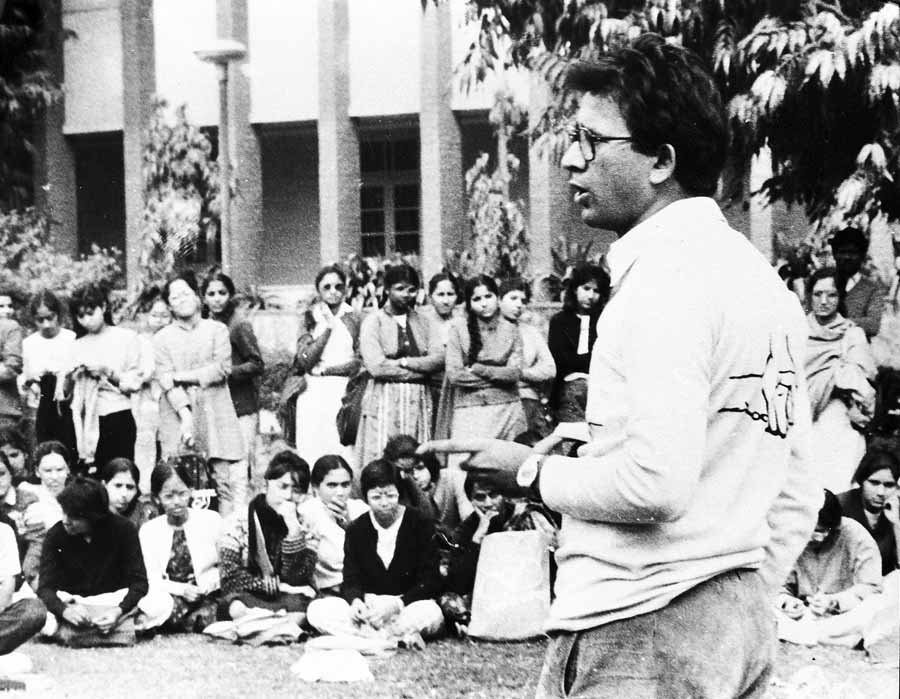
On January 4, 1989, Jana Natya Manch (Janam) convened at Jhandapur village, on the outskirts of Delhi, to complete an interrupted play. Three days before, Janam began to perform their play Halla Bol in support of Ramanand Jha's campaign for the Ghaziabad municipal elections. Jha was backed by the Centre for Indian Trade Unions (CITU), the federation…

Read more

Scoundrel times: Paris, Baghdad, Lahore…Interview with TARIQ ALI

Qalandar Bux Memon and Jacopo Moroni in conversation with Tariq Ali: Jacopo Moroni – Mr. Ali, we would like to begin by concentrating on the recent events in the French banlieues. First of all, it seems undeniable that the events are of fundamental importance for the future political and socio-cultural European landscape, forcing us to grasp for a theoretical understanding…

Read more

Israel’s Bankrupt Politics

To this historian of empire, the Israeli onslaught on the captive Palestinians of Gaza strikingly recalls the tactics of colonial counterinsurgency, as recent research by Laleh Khalili at SOAS underlines. Attempting to crush nationalist resistance, the British surrounded civilian populations with barbed wire during the Southern African War, 1899-1902. Aiming to destroy Algerian nationalism, the…

Read more

THE LAWYERS AND THE OLD GRANITE BLOCK

First Historical Note by way of Prologue 'Those who sow should eat' [Jo kheray so khai] - this was the slogan upon which the radical and revered Sufi poet Shah Inayat set up, in the 18th century, an agrarian commune.  Shah Inayat was born in Multan; in youth he affiliated himself with the Qadiriya…

Read more

Sri Lanka’s Common Future by Pradeep Jeganathan

“Every prospect pleases, but only man is vile” goes the racist, colonial refrain, which is still the dominant ‘international’ framing of ‘news’ of the coveted pearl that seems to hang from India’s ear. In this colonial story a ‘model colony’ become a ‘troubled paradise’ after the British left it kindly and quietly. In the hands…

Read more

Algeria’s Forgotten Revolutionary History

Amilcar Cabral, the leader of the Bissau-Guinean armed struggle against colonial Portugal, once said about Algiers: “The Muslims make the pilgrimage to Mecca, the Christians to the Vatican, and the national liberation movements to Algiers.” Cabral was also the first to name Algiers “capital of revolutions” in 1969. By the early 1970s, Algeria had a…

Read more