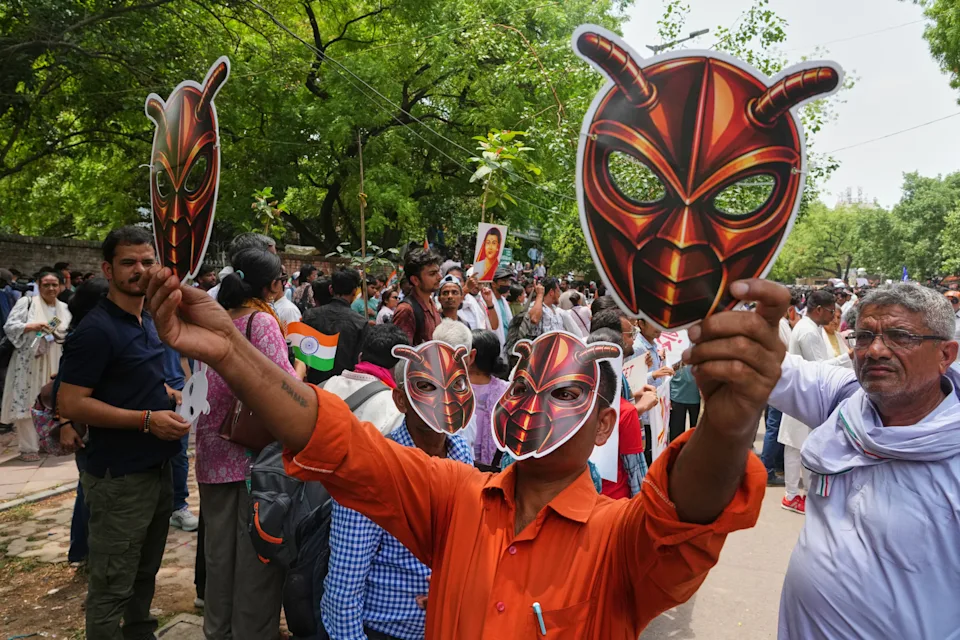
Gen Z, the Emergency, and the Making of a Usable Indian Past
B
I have spent enough of my writing life asking history to help me understand the present to know how tempting it can be. An earlier event steadies what feels uncertain now. It gives us names, sequences, people we already know how to judge. Sometimes we need that help. But sometimes the analogy arrives before attention has done its work, and what was meant to clarify the present begins to stand in front of it. There is a violence in giving the present too quickly to the past.
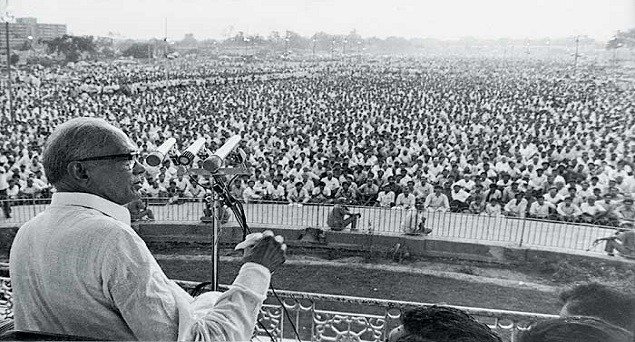
That was the unease I felt reading Sadanand Dhume’s recent account of India’s Cockroach Janta Party for the Council on Foreign Relations (CFR). The young people in his essay arrive carrying the facts of their own lives: unemployment, examinations they no longer trust, years spent preparing for jobs that remain somewhere beyond reach, anger moving into the street, and the police waiting there for them. Dhume does not dismiss any of this. Much of the indictment is present in his own account. But then Jayaprakash Narayan (JP) enters, followed by Indira Gandhi and the Emergency, and gradually the people making the event begin to stand behind the history being used to explain them.
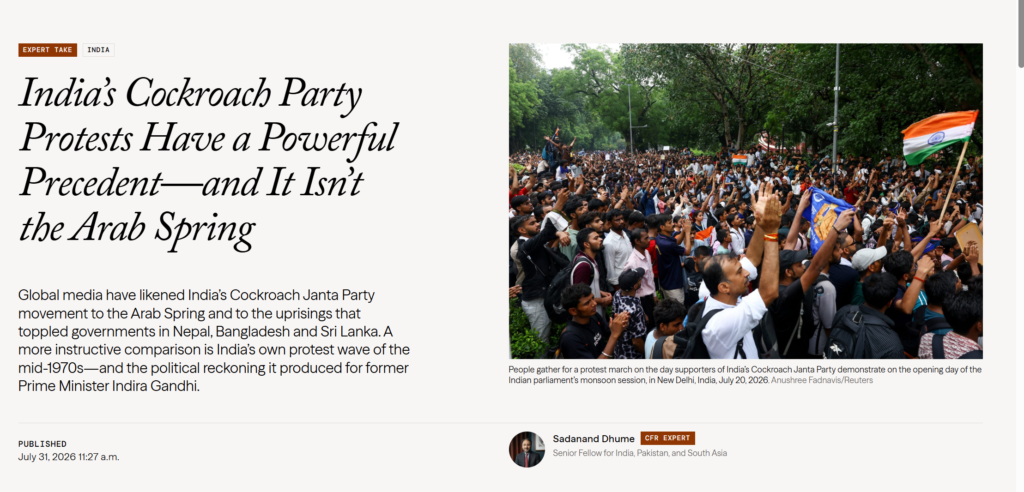
The comparison with 1974 is not foolish. If it were, there would be very little worth arguing about. The agitations in Gujarat and Bihar did grow out of student anger over corruption, prices, unemployment and the failure of political institutions to hear them. JP came out of retirement and became the great moral figure associated with the upheaval. But Dhume’s own account gives us the order: the students spearheaded the protests; Narayan emerged from retirement to lead them.
The order carries weight. The students were already there. They had begun to make the breach before the old man arrived to give it a national voice. We have lived with the phrase “the JP movement” for so long that the compression no longer strikes us. Two initials have come to contain a multitude. The students remain in the history, but largely as those whom JP led. Political memory likes a face. It likes the photograph that can be returned to, the biography that can carry a movement, the name under which the untidiness of a crowd can finally be put away.
This is what troubles me about giving the Cockroaches to JP so soon. The precedent itself contains an earlier disappearance of youth agency. Young people made the opening then, and history eventually gave the opening another name. Another generation is making an opening now, and already we are reaching for those same initials. Dhume takes away Gen Z’s agency not by belittling the protesters, but by giving their revolt an inherited meaning before we know what meaning they themselves will make of it.
A Present of Their Own
Their predicament has its own texture. There is the examination portal, the leaked paper, the coaching centre, the rented room, the result checked again after midnight, the vacancy that moves further away just as someone has spent another year preparing for it. A parent keeps paying. Another year is gone. Another birthday comes and the age limit draws closer. Dhume records the extraordinary levels of unemployment among young graduates as well as the succession of examination scandals that helped turn anxiety into anger.
All the while the country continues telling its young that they are its demographic promise, proof of a future that is always about to arrive. For many of them, that future has become another name for waiting. One studies because study is supposed to lead somewhere. One postpones earning, leaving home, helping one’s parents, sometimes marriage, sometimes the smaller beginnings by which an adult life slowly becomes one’s own. Then the examination is cancelled or compromised, the recruitment changes, the appointment does not come. What was once called sacrifice begins to feel like time taken from you.
A leaked paper does not feel like 1974 when it is your third year of preparation. A baton does not feel like historical precedent when it comes down on your shoulder. These things have dates and rooms and families attached to them, and I worry that we lose something when we turn too quickly from those details towards the comfort of analogy.
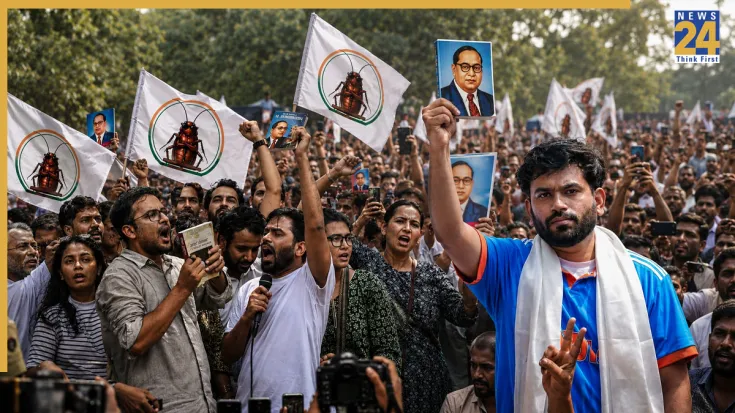
The name “Cockroach” belongs to this present too. It grew out of a remark by India’s chief justice likening a section of unemployed youth to cockroaches. Abhijeet Dipke, then living in Boston, answered online by calling on the “cockroaches” to come together. The CJP followed, and within weeks its Instagram following had overtaken the BJP’s.
Dipke may have created the handle almost in jest, but what happened afterwards could not have been authored by one person. The ecology of social media took hold of it: recognition, repetition, mockery, improvisation, the sudden discovery by strangers that an insult had named something they shared. The handle escaped its maker. What began on a screen moved into another register, until a joke became a gathering point for people carrying very real grievances and digital recognition found bodies in the street.
That passage from the handle to the crowd carries weight. No heroic inheritance was needed, no grand language of sacrifice, no dignified title supplied by people who know how a political movement ought to sound. They took the insult itself. Its force came not simply from Dipke having named something, but from thousands recognising themselves—or perhaps more exactly, recognising the contempt directed at them—inside the name.
Social media did not create their grievance. It gave the grievance speed and contact and, for a while, a common name. What first appeared as a handle acquired the unpredictable consequence of physical mobilisation. That seems to me closer to what is new in this moment than the search for a respectable ancestor.
I have encountered something of this habit in Dhume’s writing before. In my earlier rejoinder, Gaza Is Not for Sale, my quarrel was with the ease with which previous mass displacements could be brought forward to make another displacement imaginable. Partition, the Sudeten Germans, the terrible rearrangements of population that marked the twentieth century: the histories were real. My concern was with the work they began to perform once they entered the argument.
When catastrophe becomes precedent, the mind adjusts. The fact that people have been uprooted before begins to sit alongside the possibility that people might be uprooted again. Nothing has quite been justified, but the unthinkable has acquired company. History has made it less lonely.
The stakes here are entirely different, and I would distrust my own argument if it required Gaza and an Indian youth revolt to be made morally equivalent. They are not. What I recognise is narrower. Again, we reach for the past before we have properly heard the present.
The history need not be false for this to happen. The comparison need not even be wrong. The trouble begins when comparison saves us the labour of looking. Something still unfinished becomes familiar, and familiarity brings with it the sense that we already understand what kind of event this is. By the time the explanation is complete, the people living through it can begin to look like late arrivals in somebody else’s story.
What is being taken from them is political time. A generation begins to lose the right to be contemporaneous with itself.
I keep returning to that phrase because I do not know a better one. To be contemporaneous with oneself does not mean living without history. None of us does. It means being allowed some room in which the meaning of one’s own experience has not yet been decided by somebody else’s memory.
I am aware of the danger here for my own writing. It would be easy to take the Cockroaches away from Dhume only to recruit them into my argument about waiting, youth and political rupture. Sympathy can appropriate as readily as dismissal. I do not know what this movement will become. I do not know whether it will fracture, disappoint, be captured by a party, reproduce old hierarchies or simply exhaust itself. That uncertainty belongs to the movement and should not be written out of it.
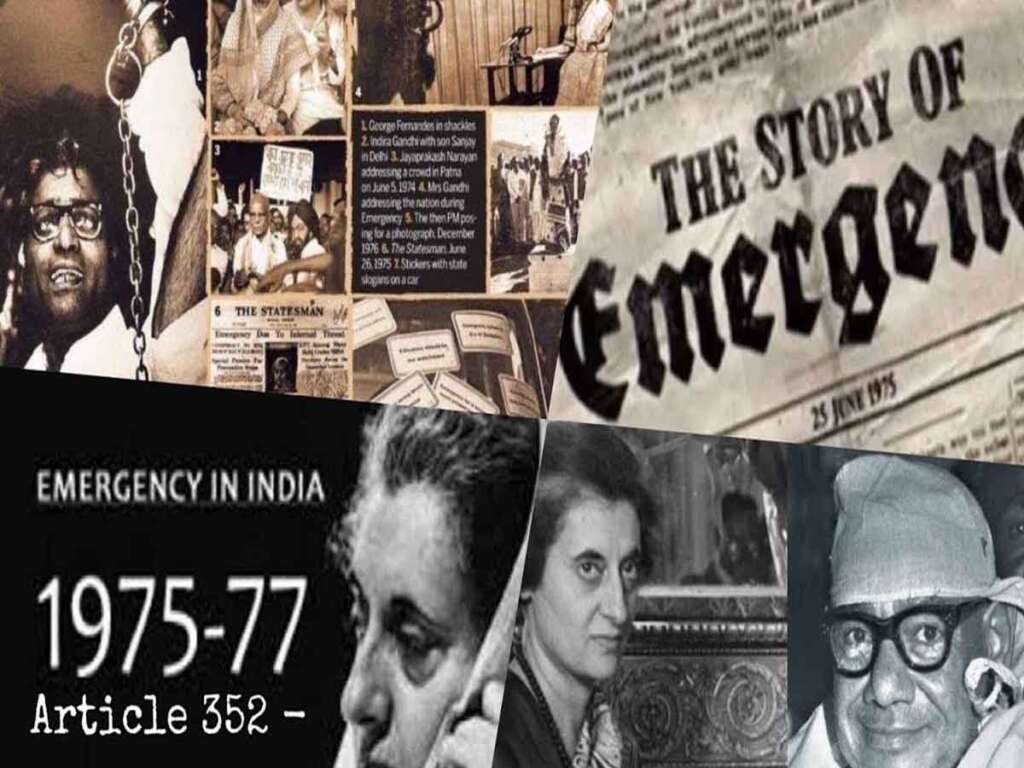
Dhume’s chosen history nevertheless has consequences. The road from the student agitations leads to JP, and from JP to Indira Gandhi and the Emergency. The Emergency remains one of the republic’s great assaults upon its own constitutional promise. But its place in Indian political memory also gives the BJP an unusually useful past. Congress carries the shame of authoritarian rule; those political traditions that opposed it retain the memory of resistance.
Modi enters Dhume’s account through precisely that history. He is not only the prime minister whose government is being confronted by angry students. Dhume reminds his international reader that Modi “cut his own political teeth” as a Hindu nationalist activist opposing Indira Gandhi’s Emergency. The detail is true. What interests me is what it does where it has been placed.
A movement has arisen from the conditions of Modi’s India. We travel backwards to understand it. By the time we return through JP and the Emergency, Indira Gandhi is again standing in the dock, while Modi has appeared, however briefly, among those who once resisted arbitrary power. The government being called to account has recovered some of the old moral light of resistance.
That past is not sitting innocently in the archive. In 2024 the Modi government formally designated June 25 as Samvidhan Hatya Diwas; the government subsequently organised a two-year national commemoration of the Emergency, culminating in June 2026, with programmes explicitly devoted to keeping alive the memory of those who resisted it. Modi himself used the 2026 observance to describe the Emergency as an assault on constitutional liberty. The government’s own account of the commemoration makes its pedagogic purpose plain.
None of this requires us to soften what Indira Gandhi did. It asks us to notice how long political credit can survive its original occasion. There comes a point when yesterday’s courage begins to behave like inherited capital.
The Hollow Centre
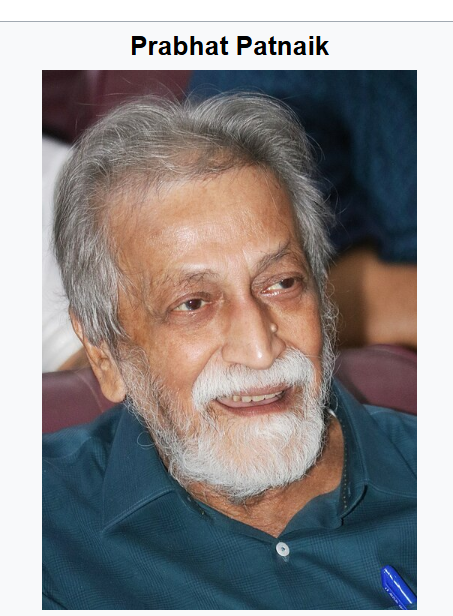
There is another way of reading what has happened, one that does not require us to travel back to 1974. Prabhat Patnaik, the Marxian economist and public intellectual, is Professor Emeritus at Jawaharlal Nehru University’s Centre for Economic Studies and Planning. He begins not with precedent but with a more immediate puzzle. Why should an examination paper leak, however serious, have released anger of this scale? His answer is that the grievance found something already waiting for it. He calls it the “moral hollowness” of the regime.
I find the phrase useful because it asks more of us than the familiar charge of hypocrisy. Hypocrisy tells us that somebody says one thing and does another. Patnaik is interested in what happens when a government derives its authority from a moral claim and then slowly empties that claim while continuing to speak in its name.
Modi’s rise cannot be separated from the corruption question. Na khaunga, na khane dunga carried more than a promise of clean administration. It condensed a political morality into the person of the leader: the old order had been compromised; this ruler would not take a bribe and would not allow others to do so. Personal probity was offered as the guarantee that public life itself could be cleansed.
Patnaik’s point is not that every person accused of corruption is guilty, or that every investigation is invented. His concern is with the instability of the category itself. Once political affiliation begins to alter the intensity with which corruption is spoken about or pursued, “clean” and “corrupt” no longer stand independently of power. The language of purification survives while the criterion underneath it begins to bend.
His argument, however, begins earlier than the BJP’s broken moral promise. In a striking essay from 2014, “Neo-Liberalism and Democracy,” Patnaik argued that democratic life depends upon some belief that participation can alter the conditions under which people live. When successive governments appear unable to depart substantially from the demands of globally mobile finance, political choice remains formally intact while its material range narrows. Despondency follows. Into that despondency comes the “saviour” or “messiah,” the figure who promises through extraordinary personal agency what ordinary democratic institutions no longer seem capable of delivering.
Seen from there, Na khaunga, na khane dunga acquires another resonance. Its promise was powerful not simply because corruption was widely resented. It offered the person of the leader as the means by which an apparently paralysed political order would become effective again. Where institutions had disappointed, character would intervene. Where ordinary politics seemed compromised, the incorruptible ruler would restore agency.
The trouble comes later. The saviour inherits the burden of the promise he has personalised. If unemployment persists, institutions deteriorate and the original distinction between the corrupt and the clean becomes compromised by the accommodations required to remain in power, the leader cannot indefinitely remain outside the failure surrounding him. Patnaik’s “moral hollowness” names something of this second exhaustion.
The argument goes further into political economy. A government can continue promising transformation while unemployment, insecurity and the narrowing of public opportunity remain unresolved. It can sound almost limitless when speaking of civilisation, nation, enemies and historical destiny, yet curiously constrained when the question turns to jobs, public provision or concentrated wealth. Patnaik places moral hollowness where the regime’s moral and material failures meet. As material renewal recedes, ideology must bear more of the burden of legitimacy; but ordinary experience keeps abrading the credibility of the moral claim.
Dhume sees a resemblance to 1974. Patnaik asks what has happened to the moral authority of a government now.
For him, the paper leak does not explain everything. It gives an accumulated contradiction a concrete form. A young person has done what the system asked: studied, competed, waited, spent years preparing. Then the institution responsible for conducting the competition cannot honour its own rules. Responsibility nevertheless continues to travel downwards. The student loses the year, the applicant carries the uncertainty, the family carries the expense. When the institution fails, responsibility has a way of dissolving into procedure.
The demand for the education minister’s resignation therefore carried more than its literal content. No resignation could repair the examination system or create jobs. But it attached failure to office. For once, consequence did not stop with the person waiting outside the institution.
This is where fear enters Patnaik’s argument, and where moral hollowness becomes a question of political survival rather than merely political credibility.
A regime does not cease to rule when people cease fully to believe in it. Disbelief and obedience can live together for a long time. A case filed against somebody else, an investigation, a career interrupted, a university disciplined, a journalist made an example of—each enters the calculations of people who have not themselves been touched. Repression need not reach everybody. Its possibility travels further than its actual use. Patnaik’s point is that coercion begins to perform work that moral authority can no longer perform on its own.
There is another protection available to such a regime. Moral authority can retreat from institutions into the person of the leader. In Patnaik’s recent writing on neo-fascism and the concept of the nation, he describes a politics in which the nation is placed above the people and the leader increasingly appears as its embodiment. Rights recede before duties; what should belong to citizenship can be presented as generosity descending from above.
What had been a claim becomes gratitude. What had been a right becomes largesse.
That helps explain why evidence of failure does not necessarily destroy a regime whose moral claims have thinned. Legitimacy has more than one register: the memory of the founding promise; residual faith in the leader even where institutions are distrusted; fear of opposing him; welfare distributed and narrated as personal benevolence; religious or national belonging organised against an internal adversary. None of these requires the regime to resolve the economic difficulties from which the original discontent arose.
Patnaik has repeatedly connected this resilience to what he calls the alliance between neoliberalism and neo-fascism: economic anger that might otherwise travel upwards can be redirected laterally, towards minorities and questions of belonging, while the underlying distribution of economic power remains comparatively undisturbed. In his argument, communal mobilisation and the protection of concentrated economic power are not unrelated features of the conjuncture. One helps shelter the other.
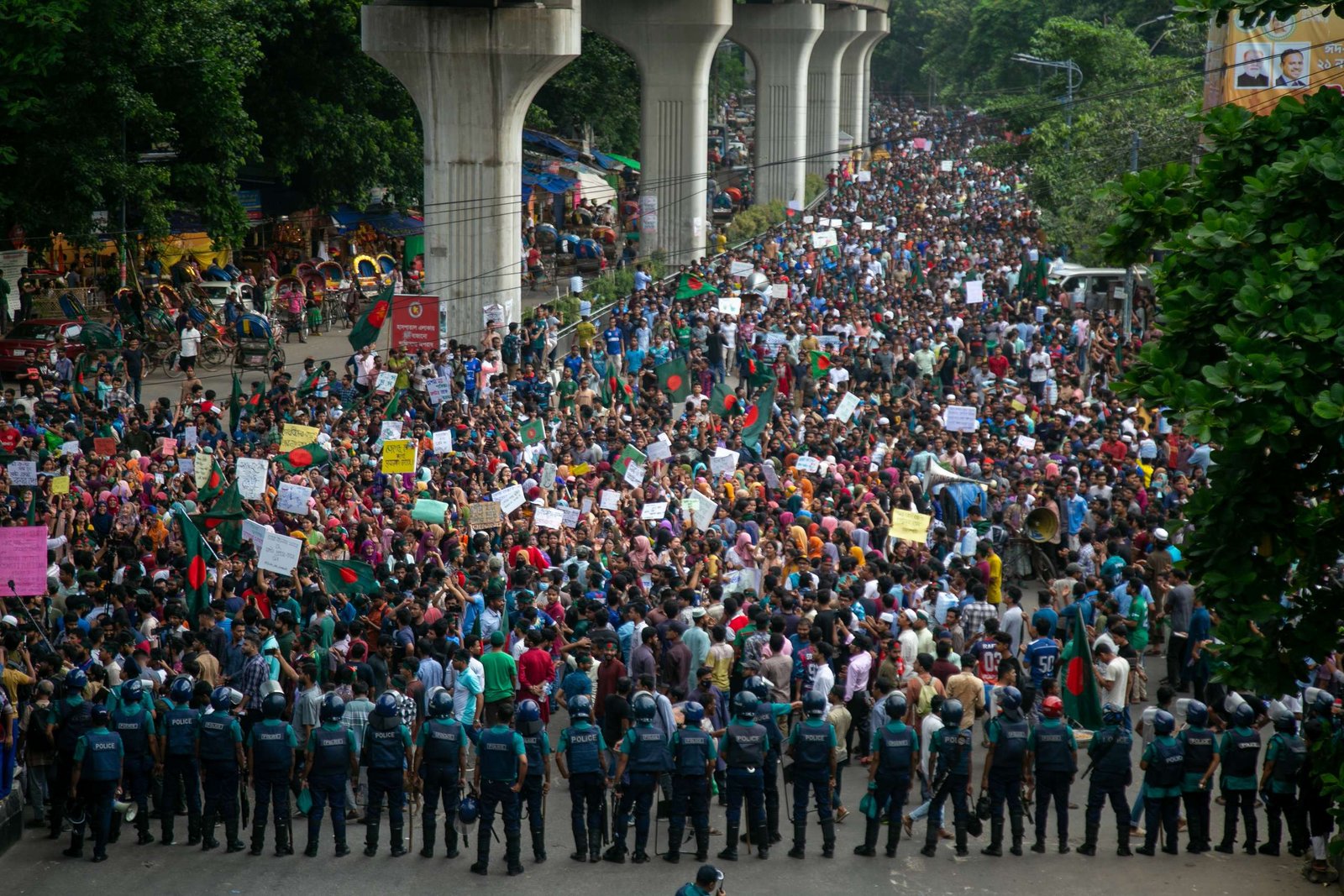
The student uprising disturbed this arrangement. On July 20, thousands attempting to march towards Parliament were met by police and paramilitary forces using batons, tear gas and pellet guns. Images travelled rapidly online. Dhume records that three days later Modi made a late-night Instagram intervention; on July 25 Education Minister Dharmendra Pradhan resigned.
Then came another late-night intervention, and with it something almost too revealing.
On July 31 Modi posted a social-media video addressing students who had abused him during the protests. He called them “misled children,” said punishment and repeated journeys to court would not resolve the situation, and announced that he wanted to forgive them. At the time, cases had been filed against hundreds of demonstrators, while the CJP was still complaining that the government’s commitment to withdraw cases had not been fully honoured. Reuters reported the intervention the following morning.
The words are gentle and that is why I find them unsettling.
The students had not come asking Narendra Modi to forgive them. They had come asking why examinations failed, why years of their lives could be squandered with so little consequence for those in office, and why the police had met their anger as they did. Yet in the Reel the moral positions quietly change. The prime minister becomes the injured party. The students become errant children. Power returns to the scene not as an institution required to answer, but as the elder who chooses mercy.
The direction of obligation has been reversed.
Patnaik’s phrase helps us see the manoeuvre. A politics that originally placed enormous moral weight upon the person of the incorruptible leader draws an institutional crisis once again towards the moral person of the prime minister. The virtue on display has changed. Once it was incorruptibility; now it is magnanimity and he forgives.
But what had been asked for was accountability.
There is something peculiar about unasked-for forgiveness when the man granting it presides over the institutions that have filed the cases. Forgiveness ordinarily follows an injury that has been acknowledged. Here the larger injury remains awkwardly outside the frame. Who answers for the years lost to a compromised system? Who carries the consequence for institutional failure? Who answers for the baton? The language of grace can become a way of moving away from the language of responsibility.
Nor was the Reel merely an isolated piece of communication. In the days after the protests, Modi and the BJP sharply expanded their use of Instagram and youth-oriented content. Reuters reported that ministers were urged to become more active on platforms favoured by younger Indians and to make their videos appear less polished; the new preference was for Reels with minimal editing and some “rawness.” The same report observed that the protesters’ own use of Instagram and short videos had challenged Modi’s carefully cultivated image of political invincibility. The shift was reported in detail here.
There is an irony in that sequence. Dipke creates a handle almost in jest; the handle escapes him; strangers make it their own; the movement passes from the screen to the street. Power then comes back to the screen hoping to recover a relation the street has unsettled.
But a different camera cannot restore a depleted moral claim.
The young had already discovered something that the language of forgiveness could not undo: the government could be made to answer. An office-holder had resigned. An apparently immovable authority had moved. Private grievance had found public company. Fear had not vanished, but the supposed immunity of power from consequence had suffered an observable defeat.
A midnight Reel cannot put that discovery back in the bottle. Nor can forgiveness, especially forgiveness nobody asked for.
The Possibility Of Another Politics
That is where Patnaik’s “moral hollowness” becomes a theory of the present. And it is also where the possibility of another politics begins to enter the argument.
For the regime still has ways of surviving the breach. Religious identity can be intensified; an internal enemy can be summoned; national danger can displace economic anger; the image of the leader can be repaired; those capable of giving a movement coherence can be isolated, absorbed or discredited. A politics unable to overcome unemployment can remain extraordinarily active in the production of belonging, grievance and threat. The economic crisis remains; political attention is reorganised around something else.
There is therefore no mechanical threshold at which hollowness suddenly becomes collapse. Patnaik gives us something more difficult. The arrangement becomes vulnerable when fear no longer succeeds in keeping disbelief private, when the aura of the leader’s infallibility is publicly breached, and when injuries endured separately begin to recognise one another.
The Cockroaches may have opened such a breach. Nothing guarantees that it will remain open.
And here Patnaik refuses the most comforting conclusion. Political defeat of a neo-fascist government, in his terminology, does not by itself abolish the conjuncture that produced it. If unemployment, economic insecurity and the narrowing of democratic economic choice remain, the conditions that gave the saviour his appeal remain available for another saviour, or for the return of the same one. His argument about the crisis of neoliberalism insists that neo-fascism can lose politically and survive historically.
Another politics, then, cannot consist merely in replacing the person at the centre. Patnaik forces the argument back towards employment, public education, health care, taxation, social rights and the power of finance. These are not an economic appendix to the struggle against authoritarianism. They determine whether a crisis of legitimacy produces another turn through the same cycle or begins to alter the political settlement that made the cycle possible.
This is what Dhume’s return to 1974 cannot tell us. The most consequential question may not be whether the Cockroaches resemble JP’s students, or even whether Modi can survive them. It is whether the breach they have opened can travel from disbelief in a regime towards a different account of what democratic power owes those who live under it.
Patnaik does not promise that passage. He insists, however, that without it the hollow centre can be occupied again.
What Stability Cannot See
This is also why the location of Dhume’s argument carries weight. CFR is not simply another publication carrying an opinion piece. Dhume is its senior fellow for India, Pakistan and South Asia, working on the region’s political economy and foreign policy. CFR properly states that his article represents his own views and that the institution takes no position on matters of policy.
That distinction should be respected. It does not make the setting irrelevant.
India increasingly enters the Western policy imagination through China, defence, technology, markets, supply chains and the Indo-Pacific. CFR’s own recent writing on the bilateral relationship describes strategic convergence around China, defence and a shared Indo-Pacific vision as central to the US–India partnership, while democratic concerns have often remained subordinate to those interests.
Every set of concerns teaches us where to look.
Follow Dhume’s essay. He rejects the analogy with the Arab Spring and with recent government collapses elsewhere in South Asia, returning the Cockroaches instead to the apparently more sober precedent of 1974. By its conclusion the question has shifted towards whether Modi can survive the unrest. The bureaucracy holds. The police and paramilitaries remain under government control. The army stays outside politics. India is too large and dispersed to be paralysed through Delhi. Modi is unlikely, Dhume concludes, to meet the fate of rulers driven out elsewhere.
These are not frivolous observations. They answer another question.
We begin with the young asking what their government has done with their lives. We end by asking whether their government can survive them.
Something has been translated along the way. An accusation about democratic life becomes a question of stability. Western strategic writing is often very good at seeing states and rather less accomplished at seeing what happens beneath them. Stability can be measured. Agreements can be signed. Armies, bureaucracies, markets and ministries can be assessed. Fear, humiliation, exhausted patience, the moment at which somebody stops believing the explanation supplied for his own failure—these sit less easily inside the policy brief.
A state can carry a great deal of democratic injury and continue to look reassuring from a distance.
What Kancha Ilaiah Shepherd notices, and what Dhume’s account does not quite reach, is fear. Ilaiah’s response is exuberant, at times much more certain of prophecy than I can be. He gives Dipke an almost providential place in the movement, and I do not share that confidence. But when he describes his own fear—the sentence reconsidered, the case anticipated, the ordinary calculation of what speaking might cost—he gets close to something harder to measure. He writes of waking with the fear of what might follow from a word that offended those around the regime, and of the CJP subsequently taking the narrative out of their control through humour and creativity.
Fear rarely begins with the police arriving at the door. Usually it has entered the room much earlier. A sentence is not written. A post disappears. A teacher avoids a subject. Someone decides not to attend a meeting. A person checks who is sitting nearby before speaking. The state cannot police every gesture and does not need to. People eventually learn to save power the trouble.
Ilaiah senses that something in this atmosphere may have moved. I am not ready to call it liberation from fear. His prophecy outruns me. Yet even his essay finally admits that no one knows what comes next. Ridicule nevertheless carries political knowledge of its own. There is a difference between fearing power and discovering that power can be laughed at in public.
Dhume ends up asking whether Modi can survive the Cockroaches. Ilaiah leaves me wondering whether fear can survive them.
I do not need Ilaiah to be right for that question to stay with us. Governments survive protests with depressing regularity. What may be harder to restore is deference once people have found themselves laughing together at what frightened them separately. Fear depends partly upon loneliness. It works best when each person imagines that everybody else is still afraid.
Here Patnaik and Ilaiah unexpectedly meet. Patnaik explains why fear must carry more of the burden when moral authority has begun to thin. Ilaiah notices what it feels like when fear becomes less dependable. Neither requires us to return to JP before we can recognise what has happened.
Dhume and Ilaiah therefore offer two readings of the present from opposite directions. Dhume looks backwards and finds 1974. Ilaiah looks at fear loosening and, perhaps too quickly, catches sight of a future. I do not want to replace one interpreter with another. The more important thing is the present caught between these readings, and the young who still have to live there.
There is a larger argument about time beneath all of this. Hindutva has spent years telling Indians which past their future should emerge from—civilisation, restoration, old injuries, recovered greatness. Dhume’s history is wholly different, democratic and anti-authoritarian, but he too returns the young to an authorised past: JP, Indira, the Emergency.
The Cockroaches may have little interest in choosing between these inheritances. Much of their political language has been formed elsewhere: on phone screens, through parody and bad taste, through jokes that collapse authority in seconds and circulate before anyone has decided whether they are permissible. None of this makes the young democratic by nature. We know too much about the internet to romanticise it. But it does mean that they inhabit a present their elders cannot completely explain to them.
Sometimes a generation becomes political not because it has discovered the right ancestors, but because the account it has been given of its own life stops making sense.
For years young Indians could be told to try harder. Take another course, learn another skill, sit another examination, wait for the recruitment, the result, the court case, the next notification. The waiting remained politically manageable while it remained private. Each person could still imagine that somebody else had succeeded because somebody else had simply worked harder.
Then people begin comparing what they have endured. The leaked paper is no longer only your bad luck. The postponed recruitment is not simply unfortunate timing. The wasted year begins to look less like a private failure. Someone who has spent months blaming himself stands among hundreds of people carrying versions of the same story.
The change is rarely as clean as writers would like to make it. I have failed does not simply disappear. People can blame themselves and the system at the same time. They can march against a government and later vote for it. Political consciousness does not arrive in a straight line. But another sentence becomes possible beside the first: something has been done to us.
That is already politics, even before it becomes a programme.
It is also why Dhume’s sentence that the protest movement of 1974–75 “eventually led to” Indira Gandhi suspending democracy catches in my throat. I understand the chronology he is describing, but chronology can acquire moral force without our noticing it. Protest did not suspend Indian democracy. Indira Gandhi and her government did. Decisions were made, orders signed, opponents arrested, newspapers censored. Those choices belonged to people who held power.
Power has always preferred to sound like weather. Tensions rose. Order deteriorated. Circumstances demanded action. The language can make agency disappear precisely where it ought to be most visible. A baton has never come down by itself; there is always a hand holding it.
The same clarity should apply to the present. These students are not unemployed under Indira Gandhi. Their examinations are not being compromised in 1975. The institutions into which they have placed their youth belong to the India in which they are living now. The police and paramilitary forces they encountered while attempting to march on Parliament on July 20 belong to now.
The Emergency may help us ask questions of the present. It cannot be permitted to answer them.
There is something uncomfortable in asking the dead to do quite so much work for us. JP must explain the protesters. Indira must supply the authoritarian danger. The Emergency must tell us how bad things can become. Modi acquires an old credential from resistance and then, after the young force his government to answer, appears on their medium offering forgiveness they never requested.
All the while the young remain inconveniently alive and unfinished, capable still of becoming something none of these histories has prepared us for.
I want to leave them some room. Let the Cockroach remain an ugly name for a little longer. Let the jokes be undignified and the politics unfinished. Let the movement disappoint those already preparing to claim it. Let it fail, if it is going to fail, without first being made into a morality play about 1974. Historians will find their lineages soon enough. History always gets its turn.
But these young people have not gone home yet. They are not standing beneath a portrait of Jayaprakash Narayan asking to be admitted into his story. They are standing before institutions of their own time with years of their own lives in their hands.
I do not know what they will finally ask of India, or what India will permit them to ask. One question, though, has become difficult to escape: What have you done with our years?
It belongs to them before it belongs to Dhume, Ilaiah, Patnaik, Modi, me, or any of us who write about them.
Perhaps the least history can do, for once, is not answer too quickly.
.