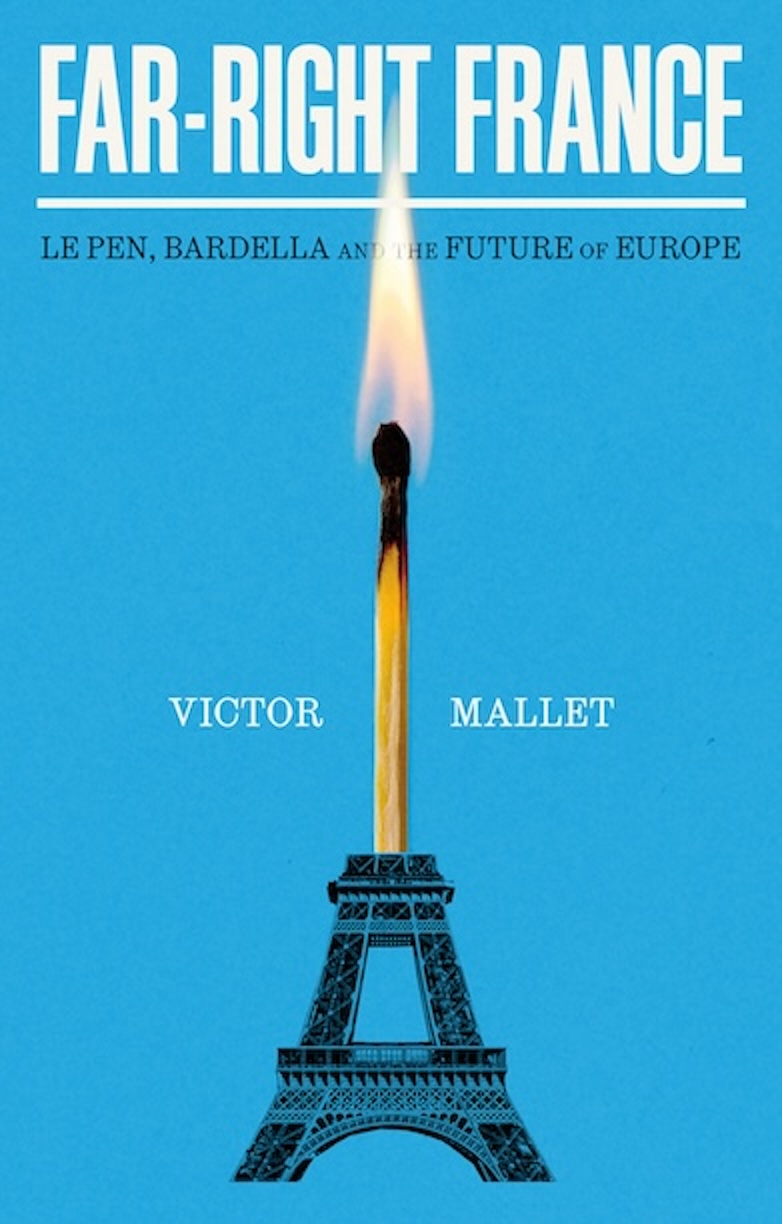
Victor Mallet’s Far-Right France is a field guide to how the RN becomes ordinary: centre exhaustion, party professionalisation, media-driven fear, and grievance turned into destiny. France’s “moment de bascule” is not just French; it is a European threshold with Atlantic consequences, and it helps decode what’s unfolding south of our border, where immigration enforcement in Minneapolis has spilled into protest and lethal force.
There are political moments when nothing “happens” in the theatrical sense. No tanks, no coup, no date that can be framed and hung on the wall. And yet the atmosphere changes so completely you realise you have been living in the afterlife of an older order. The future does not kick the door in. It leans on it. It tests the latch. It waits for your exhaustion to do the rest.
Victor Mallet’s Far-Right France: Le Pen, Bardella and the Future of Europe is written from inside that pressure, from the sense of a polity being urged, steadily, into a new register of the possible. A single word appears in his notes, offered as a private key to the public drama: basculer, to tip, to pass a threshold (Mallet, p. 231). That one verb is more honest than the genre of punditry that still speaks of “swings” and “waves,” as though the far right were merely weather. Mallet’s argument, in effect, is that France has not been caught in a storm. It has been learning a new climate.
If I bring my own writing into the room, it is not to compete with Mallet’s book. It is because the book’s central sensation is one I have tried to name in real time. In my Paris dispatch, I begin with Houellebecq’s wound of the present, “we carry it around like an abscess of suffering,” and then land in the street’s vernacular diagnosis: “C’est dingue!” The point is not flourish. It is accuracy. It is the feeling that France is being asked to treat structural dislocation as a passing crisis. Mallet, more reportorial and less barbed, writes in the same key. The centre cannot govern as it once did, yet still performs the gestures of command. The far right grows not simply by persuasion, but by habituation.
A book that refuses the comfort of surprise
Mallet declares his intent early and plainly. This is not a pamphlet “to campaign against extremism, fascism and racism.” There are many such books, he notes. He “wanted to understand and explain why the Le Pens and their successors are so popular, why their voters are so angry and why French society is so divided…” (Mallet, p. x). That choice matters. Moral alarm has its place, but it often flatters the alarmed. It lets the centre pose as innocent, shocked, therefore clean. Mallet’s wager is that the far right has become too embedded, socially, culturally, electorally, to be met by scolding. He treats it as a political formation with a history, a geography, a media infrastructure, and an expanding capacity to feel ordinary.
That last point is what makes the book unsettling. The far right’s advance, Mallet suggests, is not a matter of one decisive victory. It is the slow lowering of thresholds. People who would never have marched behind Jean-Marie Le Pen now vote RN without feeling they are crossing a moral border. The act becomes banal. And once it becomes banal, it becomes durable.
Mallet begins, rightly, with the rupture the French establishment tried hardest to misunderstand: the Yellow Vests. Not because they were “far right” in any simple sense, but because they made visible a fact the centre preferred to treat as noise. A vast part of France experienced the state less as protection than as pressure. The protests ignited around Macron’s fuel tax plan and metastasised into a wider rebellion against contempt, against a political culture that seemed to administer life from a distance (Mallet, p. 23). Mallet’s skill here is to avoid romanticising the movement while still taking seriously what it revealed. A politics organised around “reform” can feel, on the ground, like humiliation.
This is where the RN becomes less an aberration than an inheritance. If your life has been structured by declining services, stagnant prospects, and the persistent sense that Paris speaks about you rather than to you, then the far right’s promise, however false, however vicious, can feel like recognition. Mallet does not reduce this to economics, nor does he allow culture to become a substitute for political economy. He keeps returning to the lived split between a metropolitan France fluent in cosmopolitan governance and a peripheral France that experiences modernisation as dispossession. The far right, in this telling, offers not only policy but dignity. It is often a poisonous dignity, premised on exclusion. Still, it is offered, and it is felt.
Macron as incubator
The book is nominally about Le Pen and Bardella, but it cannot avoid Macron, because Macron is one of the conditions of their rise. Mallet understands him as the embodiment of a centrist project that promised transcendence, “neither left nor right,” and delivered a tightening of the political field. Macron’s presidency did not invent French anger, but it reorganised it. It gathered disparate resentments into a clearer opposition. Not left versus right, but the governed versus the governing style.
My own shorthand for him, “Le Disrupteur” has always carried a double edge. Disruption can mean liberation. It can also mean demolition. In my account, the disruption is inseparable from the spectacle of a president who breaks the old party system and then discovers the violence of the vacuum he created. I wrote that he was “scrambling to untangle himself from a mess of his own making.” Mallet does not write with that irony, but he documents the same structural irony. Macron’s gamble against the old order weakened buffers, parties, unions, mediating institutions, through which a society metabolises conflict. In the absence of those buffers, politics goes raw. The far right thrives in rawness.
Mallet is excellent on the Le Pen dynastic drama, not for its gossip value but because it illustrates how ideology survives by changing costume. Jean-Marie Le Pen appears as origin, toxin, template. Marine appears as strategist. The story of “detoxification,” dédiabolisation, is not told as moral evolution but as organisational intelligence. Soften the image, widen the coalition, keep the resentments, refine the language. In Mallet’s account, Marine’s achievement is not simply that she made the RN less repulsive to polite society. It is that she trained polite society to live with the party’s presence as though it were a normal option in a normal democracy.
Here Mallet’s temperament as a reporter becomes a strength. He refuses to treat “normalisation” as an abstraction. He shows it as a sequence of practical adjustments. Who appears on television, which scandals are disavowed, which vocabulary is retired, how candidates present themselves, how alliances are hinted at and tested. The far right grows by becoming boring. That is one of the book’s most devastating implied claims.
Bardella and the genius of banality
The Bardella chapters are the book’s most contemporary, written with the feeling that the author is documenting not a completed era but a moving succession plan. Mallet quotes Le Nouvel Obs warning that Bardella is “a worrying phenomenon” because he appears to many to be “a new man, clean and smooth” (Mallet, p. 109). That phrase contains the entire danger. It is not moderation. It is cosmetics. It is the removal of the visual cues that allow a society to recognise extremism as extremism.
Bardella, in Mallet’s portrait, is a technical solution. He lowers the social price of voting RN. He turns a decision that once required defiance into a gesture that can be made casually, even stylishly. He also articulates the strategy explicitly. Mallet quotes him defending “this strategy [of normalisation]” and insisting: “Normalisation is a step towards maturity for a political movement” (Mallet, p. 111). Read plainly, it sounds like democratic growth. Read carefully, it is the far right describing its plan to become indistinguishable from governance.
Mallet’s crucial contribution here is to make visible the RN’s professionalism. The far right is no longer merely a scream at the gates. It drafts policy, courts donors, disciplines candidates, learns to speak in the language of competence. A democracy that assumes extremism will always announce itself with vulgarity is a democracy preparing to be fooled.
Media as infrastructure
No account of the contemporary far right can remain confined to party structures. Mallet devotes serious attention to the media sphere, particularly the networks shaped by Vincent Bolloré. The point is not simply that partisan media exists. It is that a media ecosystem can set the emotional default of a society. If public life is trained to experience politics as permanent menace, crime, immigration, cultural decline, then the far right does not have to win arguments. It only has to appear as the party willing to do something, anything, to stop the fear.
Mallet’s handling is persuasive because it is specific. He treats “France’s Fox News” not as a lazy metaphor but as a political technology, a conversion of attention into resentment, outrage into identity, identity into vote (Mallet, p. 185). The RN’s rise, in this frame, is not purely electoral. It is epistemic. The far right becomes the common-sense interpreter of reality.
This is also where Mallet’s quiet indictment of the centre lands with force. Mainstream politicians often respond to this media climate by borrowing its language. They talk tougher, sound harsher, gesture toward “order,” in the hope of outflanking the far right. Mallet shows how this rarely works. It legitimises the far right’s framing while leaving the far right free to set the terms. The centre becomes an imitator, not an author.
Mallet’s section “To Russia With Love” places the RN in a wider landscape of international alignment. Whatever the party says now, its history of financial ties and rhetorical sympathy for Putin-era politics remains part of the record, and part of its vulnerability (Mallet, p. 197). The story is not simply “foreign influence.” It is affinity. It is admiration for sovereignty-as-force. It is contempt for pluralism. It is the shared narrative that liberal democracy is decadent and must be restored through discipline.
This matters because the RN is no longer merely a French phenomenon. It is a node in a broader European pattern. Mallet’s book is at its best when it warns that the far right learns from itself across borders. It shares tactics, launders language, adapts to the media age’s appetite for conflict.
The courtroom as accelerant
If the far right’s slow march depends on normalisation, nothing tests normalisation like scandal, especially scandal with legal consequences. Mallet devotes a late chapter to the embezzlement case that struck at the RN’s claim to represent “the people” against corrupt elites. His summary is precise: Marine Le Pen is sentenced to four years in jail, two suspended, two to be served under home surveillance with an ankle bracelet, fined €100,000, and disqualified from standing in elections for five years (Mallet, p. 208). Alongside her, others are found guilty of détournement de fonds publics, embezzlement (Mallet, p. 208).
But the political story is not simply the verdict. It is the reaction. Mallet quotes Bardella’s response: “it is French democracy that has been executed” (Mallet, p. 209). This is the martyr script, now almost automatic. Accountability becomes persecution. Legal judgment becomes proof of conspiracy. The far right, even when caught diverting public funds, still manages to stage itself as the victim of “the system.”
Mallet is alert to the toxicity of this moment. He notes that even some rivals feared the optics. Excluding a popular candidate before all appeals are exhausted can look like manoeuvre, and the far right will exploit that perception (Mallet, p. 209). The danger is not only that the RN breaks rules. It is that every attempt to enforce rules becomes, in the RN’s narrative machine, further evidence that democracy itself is a rigged performance.
“Inevitable”
Near the end, Mallet includes a line from Le Pen that reads like prophecy and threat at once: “In a way, our victory is inevitable” (Mallet, p. 228). “Inevitable” is what politics says when it wants to turn history into fate, when it wants to convince you that resistance is childish, alternatives are fantasy, the only adult posture is acceptance.
Mallet does not accept that framing, but he recognises its power. The RN’s ambition is not merely to win. It is to persuade France that it cannot lose. That is how democracies drift, not only through ballots, but through the weakening of belief in the possibility of another future.
So what kind of book is Far-Right France? It is, fundamentally, a correspondent’s book: lucid, specific, textured, deeply attentive to the practical mechanics of political transformation. It excels at showing how the far right becomes plausible. It shows how it roots itself locally, recruits and disciplines, feeds on the centre’s failures, rides media currents, prepares for power.
Its restraint is also its risk. Mallet sometimes treats the far right’s rise as something to be explained rather than something to be anatomised morally. There are moments when the book’s fairness, the desire to “understand,” looks like cautiousness around the RN’s ideological core. Race, Islam, and the afterlives of empire are not side issues. They are structural engines of far-right identity. Mallet is not blind to these forces, but he is more comfortable describing their political utility than confronting their deeper psychic inheritance in the Republic.
Yet even this limitation has its own use. The book’s calmness underlines the horror it documents. The far right no longer requires hysteria to advance. It can advance in the register of reason. It can speak in the language of “maturity.” It can appear “clean and smooth” (Mallet, p. 109). That is precisely what should frighten a Republic that still thinks extremism will always be crude enough to recognise.
The book’s achievement
In my Paris dispatch, I described the National Assembly as an “elaborate maze with no apparent exit.” Mallet’s book is, in part, a map of how that maze was built. It traces how managerial arrogance, the erosion of solidarity, and the weaponisation of cultural fear created a polity in which the far right can plausibly claim to be the only exit.
Far-Right France gives the RN reasonable space not by indulging it, but by taking seriously what it has become. It is a disciplined political project positioned to inherit a Europe whose liberal centres have exhausted their moral credibility. Mallet does not ask you to panic. He asks you to look.
And after you look, basculer stays with you, not as prediction but as sensation. You begin to feel it in the air. The faint, unmistakable pressure of a society leaning toward something it once swore it would never become (Mallet, p. 231).