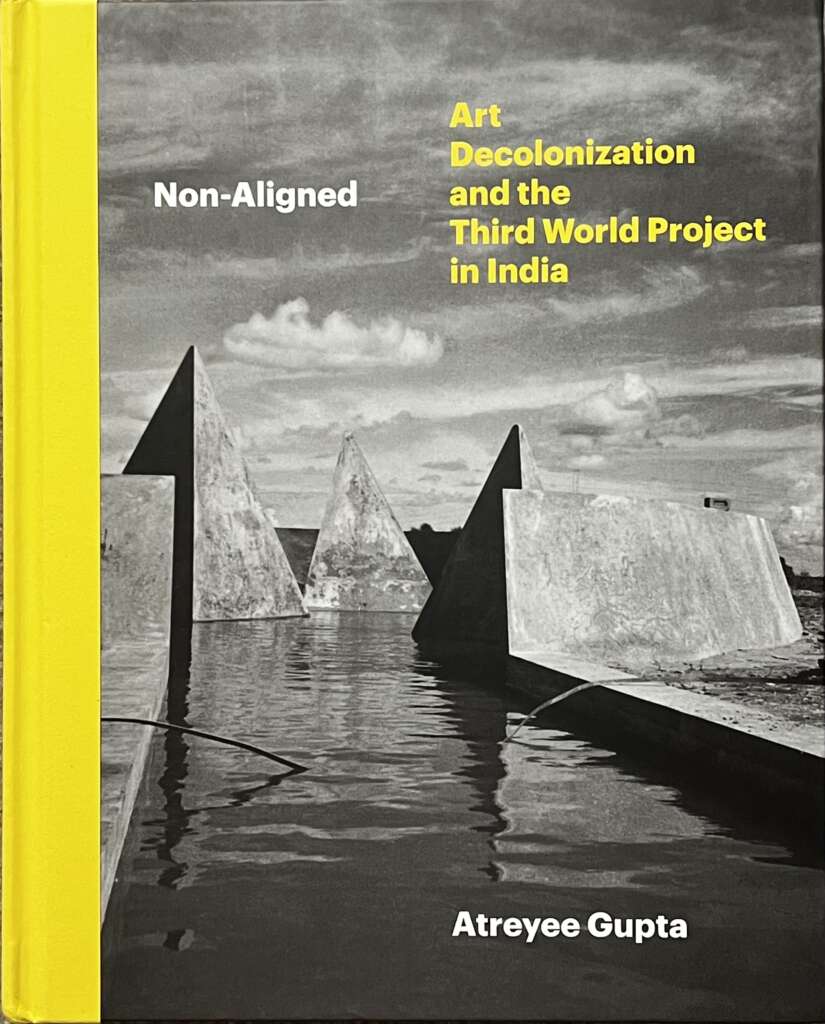
Atreyee Gupta’s Non-Aligned does not simply recover a forgotten Third World modernism; it asks whether modernism itself must be rethought when decolonization, development, and anti-imperial thought are treated as conditions of form.
Modernism’s problem was never simply that it excluded the rest of the world. Its deeper violence was that it made Europe’s experience of rupture, freedom, form, and historical consciousness appear universal, then asked everyone else to arrive late.
The importance of Atreyee Gupta’s Non-Aligned: Art, Decolonization, and the Third World Project in India lies not in expanding the geography of modernism, but in forcing art history to ask whether its most cherished categories were provincial from the start. Gupta’s own argument moves in precisely this direction: she is not seeking admission for Indian modernism into an already enlarged global field, but asking what happens when that field is made answerable to anti-imperial struggle, underdevelopment, racial colour, Afro-Asian solidarity, and the unfinished intellectual project of the Third World.
Much of what now passes under the name “global modernism” remains additive. It expands the map without altering the logic of the map. It includes more geographies, more artists, more exhibitions, more peripheries retrospectively made visible to the centre. Yet the governing structure often remains intact. Europe keeps the authority of origin; the rest of the world is granted variation, translation, resistance, adaptation, belatedness. Gupta refuses this arrangement. Her book does not merely provincialize Europe by reversal. It provincializes the habits through which Europe continues to organize the global.
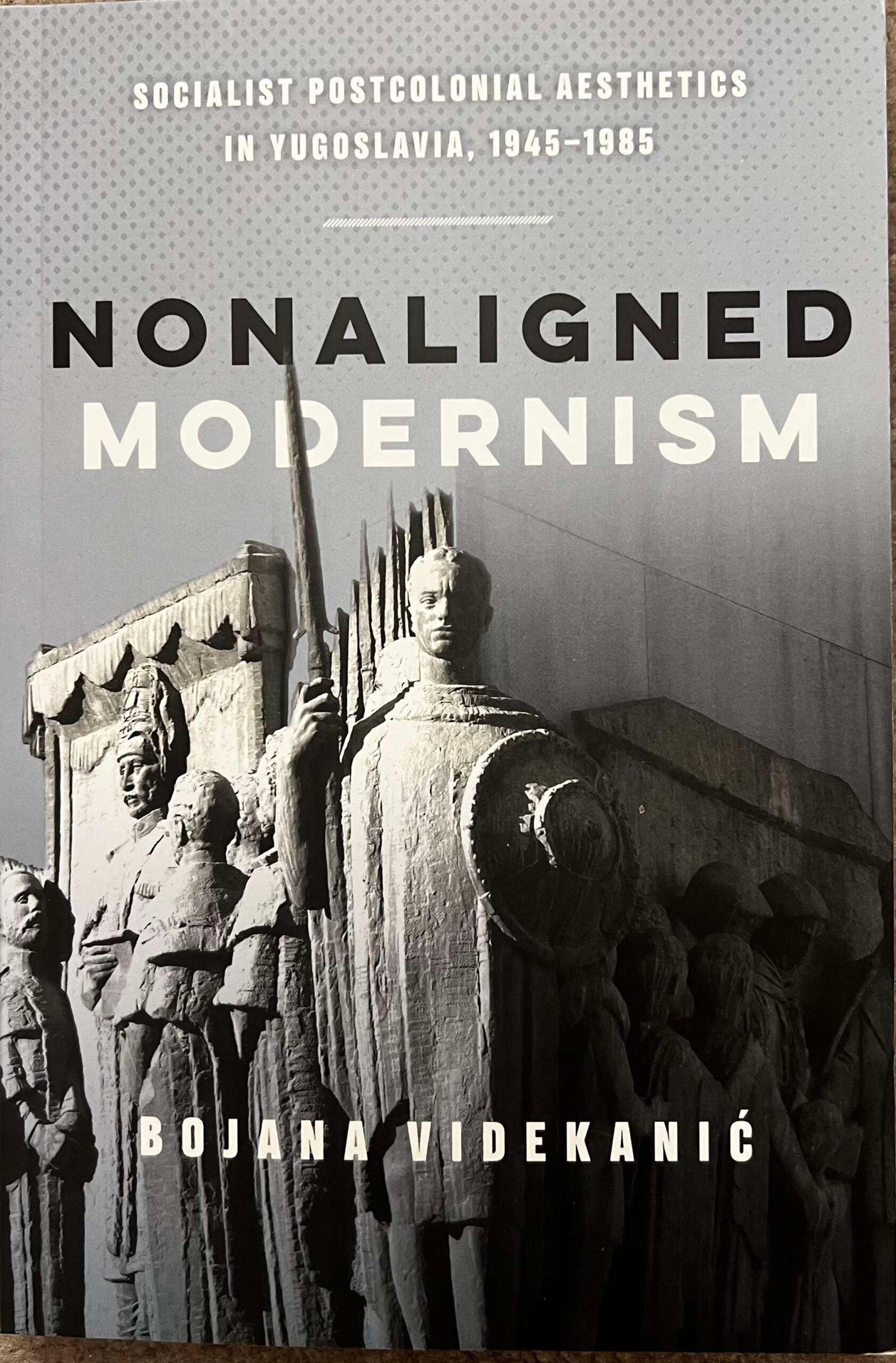
In Bojana Videkanić’s Nonaligned Modernism: Socialist Postcolonial Aesthetics in Yugoslavia, 1945–1985, non-alignment appears above all as institutional form: socialist cultural policy, exhibition diplomacy, the figure of the cultural worker, and the attempt of a European socialist state to inhabit the Cold War otherwise. Videkanić’s Yugoslavia was not postcolonial in India’s sense. It was not a colonized nation emerging from imperial rule. Its postcoloniality was positional, aspirational, diplomatic: a self-fashioning through solidarity with Asia, Africa, and Latin America, while still negotiating its European location and socialist state apparatus.
Gupta’s India, by contrast, foregrounds non-alignment as epistemic disturbance. Where Videkanić helps us see the institutional infrastructure of non-aligned culture, Gupta presses on the categories through which modernism itself has been read: influence, abstraction, colour, development, belatedness, universality. In Gupta, non-alignment is less a programme than a way of reading. It asks art history to stop treating decolonization as scenery and begin seeing it as a force that alters the very terms of aesthetic judgment.
Read together, the two books prevent two opposite reductions. Videkanić guards against making non-alignment too ethereal, as if it were only a dream of Afro-Asian solidarity floating above states, exhibitions, bureaucracies, and cultural policy. Gupta guards against the opposite error: reducing non-alignment to statecraft, diplomacy, or socialist branding. One gives us the infrastructure of non-alignment; the other gives us its conceptual insurgency.
The book is not without its risks. Once the “Third World” becomes method rather than geography alone, it can begin to resemble another free-floating global abstraction: capacious, morally attractive, but insufficiently anchored. Gupta mostly resists this drift. Her Third World is not a mood, but a historically charged formation produced through imperialism, race, development, inequality, and struggle.
Provinces of the Universal
One of Gupta’s most consequential distinctions is between the Third World as geopolitical formation and the third world as intellectual stance. The former names states, conferences, alliances, Bandung, Nehru, Nasser, Nkrumah, Sukarno, Tito, and the compromised history of postcolonial statecraft. The latter names something less easily institutionalized: a way of thinking that is anti-imperial, relational, insurgent, and committed to a world not organized by imperial universality.
This distinction allows Gupta to escape both nostalgia and embarrassment. She does not romanticize the Non-Aligned Movement as a lost utopia of solidarity, nor does she discard the Third World as an obsolete Cold War category to be replaced by the smoother institutional language of the “Global South.” That phrase, for all its usefulness, often travels too easily through museums, universities, biennials, and funding structures. It can describe inequality without naming imperialism. “Third World” retains the heat of accusation. Gupta wants that difficulty preserved.
Gupta’s acknowledgments already disclose the book’s own intellectual conditions. As she notes there, Non-Aligned bears little resemblance to her dissertation and was largely researched after the doctorate. This is not incidental. It suggests a second formation, a deliberate departure from inherited scholarly pathways. Gupta also names the intellectual atmosphere around Okwui Enwezor, especially his reflections on artistic form and national liberation movements, as foundational to the book’s thinking.
This inheritance is consequential. Enwezor’s curatorial proposition, especially in the ambit of Postwar, was that twentieth-century art could not be understood through the exhausted binary of American abstraction and Soviet realism, nor through the old metropolitan sequence of Paris and New York. Gupta takes that proposition into Indian art history, but she does not simply localize it. She makes India a site from which the discipline’s assumptions can be unsettled.
Gupta’s opening use of Abanindranath Tagore’s Khuddur Jatra is therefore especially effective. In her reading, a monumental African figure tears through the flimsy paper architecture of the Arc de Triomphe. The black body, drawn from a racist image-world, is reworked, crowned, made sovereign by the artist’s intervention. Indian anti-colonial activists appear below. Africa and Asia are brought into visual proximity before Bandung, before formal non-alignment, before the diplomatic vocabulary of Afro-Asian solidarity had taken shape. Gupta does not read this image as prophecy. That would be too simple. She reads it as latency. The collage suggests that third-world consciousness existed before its political naming. Bandung did not invent this imagination; it consolidated, amplified, and gave diplomatic form to energies already circulating through art, literature, anti-fascism, print culture, and anti-imperial thought. The point is not that Abanindranath anticipated the future. The point is that art was already cutting and rearranging the imperial image-world before politics had named the formation.
Collage becomes, in this sense, more than medium. It becomes an operation. Empire’s images are seized, torn, displaced, and made to signify against themselves. The colonized subject does not enter world history by polite inclusion. He appears by rupture. Gupta asks art history to do something similar to its own inherited instruments: cut them from their imperial ground, rearrange their relations, and test whether they can still bear the weight of decolonization.
In Gupta’s account, Mulk Raj Anand is central to this normative architecture. He is not simply the novelist of Untouchable, the editor of Marg, or the progressive cultural broker of Indian modernism. He is the figure through whom anti-fascism, anti-imperialism, Marxism, modernist internationalism, and humanist critique converge. Gupta’s discussion of Anand’s 1941 intervention at the PEN symposium gives this argument its moral core: how can any declaration of freedom pass India by without becoming hypocrisy? Freedom cannot remain a European abstraction. It must be tested where it is denied. The colonial world is not outside Western humanism; it is where Western humanism is exposed.
That is one of the book’s deeper claims. Decolonization is not merely a political transfer from empire to nation. It is an epistemological challenge to the universal. What happens to the universal human subject once those excluded from its protections begin to speak, paint, write, assemble, and theorize? What happens to modernism when those told they are late begin to contest the authority that defines lateness?
Plans Dream, Forms Resist
This question gives Gupta’s treatment of underdevelopment its force. Development is not an obvious art-historical category. It belongs to economics, planning, infrastructure, dams, factories, hunger, poverty, statistical regimes, and Five Year Plans. Gupta’s intervention is to insist that in postcolonial India development was not merely background. It entered artistic life as both psychic burden and formal problem. To be underdeveloped was not simply to lack resources. It was to be placed in a temporal hierarchy. It was to be told that one’s present was someone else’s past.
Underdevelopment, then, is not only material. It is temporal humiliation. It produces a wound in historical consciousness. Gupta’s argument allows abstraction to be read differently under this sign. Indian abstraction is not belated borrowing from Europe or America, nor simply a flight from social content into autonomy. It belongs to a world in which construction, planning, scarcity, technological aspiration, and the desire for freedom were entangled. Form becomes a way of negotiating the insult of being assigned to the waiting room of modernity.
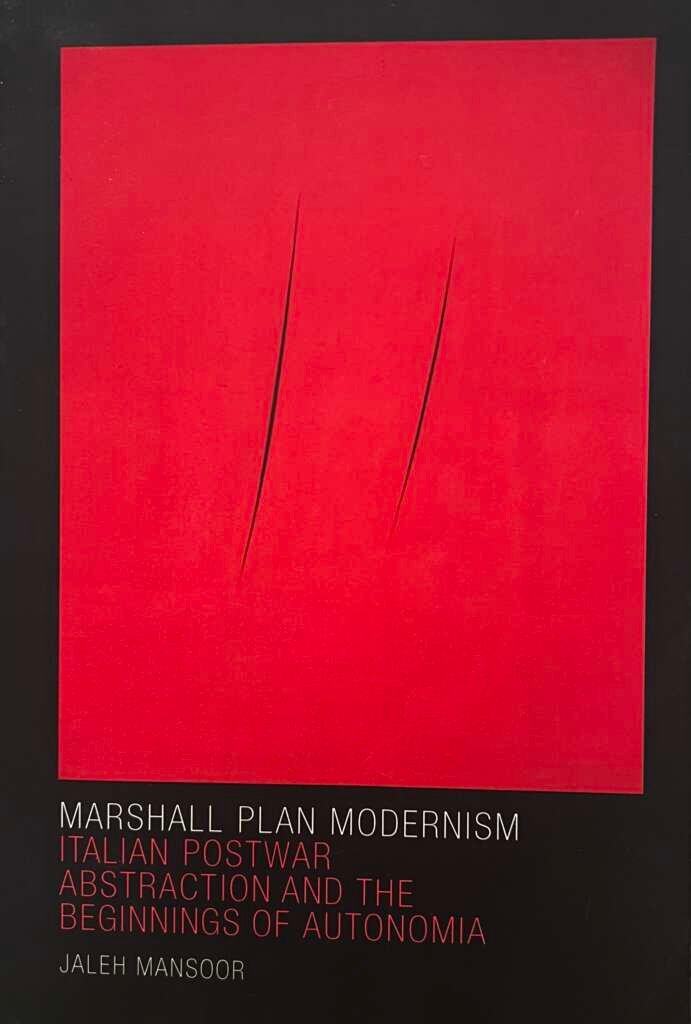
Here Jaleh Mansoor’s Marshall Plan Modernism does not merely provide a European comparison; it unsettles the very distinction between development and underdevelopment on which Cold War modernity depended. Mansoor argues that postwar Italian abstraction should not be read as pure aesthetic autonomy, nor simply as the afterimage of fascism and war, but as a response to reconstruction, labour discipline, productivity regimes, the Marshall Plan, and American geopolitical hegemony. Her insight matters here because it reveals development itself as a coercive aesthetic environment. Europe was not simply the site from which modernity radiated; postwar Italy, too, was being reorganized, tutored, financed, disciplined, and made productive. If Gupta shows how underdevelopment entered the aesthetic imagination of postcolonial India, Mansoor shows that development was no neutral opposite. It was the other face of the same world system: a machinery of aid, labour, reconstruction, and dependency that shaped the very surfaces, gestures, and refusals of abstraction. Modernism was not only responding to modernity. It was registering the economic commands through which modernity learned to speak in the language of freedom.
This comparison sharpens a latent question in Gupta. Can non-aligned modernism be read not only through freedom’s imagination, but also through development as coercive form? Nehruvian planning, industrialization, and modernization were tied to aspirations for collective emancipation, but they were also disciplinary projects. They organized labour, space, time, citizenship, and progress. They carried within them technocratic authority, caste-blind national planning, displacement, and elite command over the meaning of the future. Gupta’s treatment of development as an art-historical category is original; Mansoor’s framework intensifies the critique by asking whether development in the decolonizing world should be read simultaneously as promise and command.
This does not undo Gupta’s argument. It deepens it. The politics of non-aligned art may have been shaped as much by resistance to developmental reason as by the emancipatory horizon development claimed to open. The dam, the factory, the plan, the grid, the diagram, the constructed surface, the abstract field: these may register not only the optimism of world-building, but also the demands of productivity, discipline, and state imagination.
It also unsettles the hierarchy by which Western artists are granted philosophical abstraction while postcolonial artists are made to carry nation, identity, tradition, poverty, or spirituality. The European abstractionist may be read through ontology, perception, materiality, negation. The Indian artist is too often asked to explain culture. Gupta refuses this asymmetry. The intellectual life of form in India was no less theoretical, no less self-conscious, no less modern. The issue is not whether Indian artists arrived late. The issue is who possessed the authority to define lateness.
Gupta’s discussion of Jagdish Swaminathan turns on his complaint about the necessity of living through “second-hand experiences” in a technologically backward society. The phrase names this condition with painful clarity. Her reading of his work is therefore not a return to mystical timelessness or nativist primitivism. It is a reading of temporal refusal. Swaminathan’s turn toward anteriority, infinity, and the transhistorical becomes a rejection of developmental chronology. He does not step outside history. He refuses the schedule history has imposed upon him.
That distinction is crucial: what appears as withdrawal may in fact be critique; what appears as timelessness may be an assault on the time of underdevelopment.Gupta’s argument changes the stakes of interpretation. The question is not whether the postcolonial artist is modern enough. The question is what forms of time modernism has allowed itself to recognize.
Her reading of F. N. Souza’s black paintings extends the argument into the terrain of race and colour. Black, in this account, is not simply pigment, surface, value, hue, or monochrome. It is a historical material saturated by racial meaning. This is a necessary disturbance of formalist innocence. Colour in painting has never been purely optical. It is bound to skin, colonial taxonomy, desire, fear, projection, and violence. To read Souza’s black paintings alongside Négritude, Fanon, civil rights, and postwar racial consciousness is to insist that pigment and epidermis cannot be kept apart by disciplinary decorum.
Souza, however, is not an easy figure for decolonial redemption. His work is abrasive, Catholic, erotic, grotesque, self-mythologizing, formally violent, often misogynistic. The strength of Gupta’s reading depends on preserving that difficulty. If Souza is made too useful to solidarity, he becomes less interesting. His black paintings matter because they do not console. They force the question of how race enters painting without allowing painting to become merely illustrative of politics.
Bandung Does Not End
Gupta’s postscript, “India, ‘Third World,’ Anywhere,” is the book’s methodological reveal. It makes clear that Berkeley is not merely the place from which Gupta writes. It is part of the argument. The postscript returns to Richard Wright’s astonishment before Bandung, then moves backward to Dhan Gopal Mukerji and W. E. B. Du Bois, and forward to the Third World Liberation Front strike at Berkeley in 1969. This is not a decorative widening of scope. It tests the book’s central proposition: if the Third World is an intellectual stance rather than a fixed geography, then it can appear in India, Black America, diasporic literary exchange, anti-colonial Asia, student revolt, labour solidarity, and the university.
In Gupta’s reading, Richard Wright’s response to Bandung matters because he recognizes the gathering not as diplomatic theatre but as world-historical judgment. The rejected of empire were not asking to be included in Western humanism. They were indicting it. His wife’s remark, “Why, that’s the human race,” could sound naïve now, even embarrassingly universalist. Gupta allows us to hear it differently: Bandung did not claim the human as already given. It exposed the fact that the human had been racially and imperially rationed.
Gupta’s vignette on Dhan Gopal Mukerji is especially revealing. His arrival in San Francisco, his impatience with American provincialism, his attraction to socialists, anarchists, and agitators, and his itinerant life between India, Japan, America, literature, and anti-colonial politics allow her to locate third-world consciousness before the Third World. Mukerji’s in-betweenness produces an alternative map: caste in India, racism in the Bay Area, South Asian labour in the Pacific Northwest, spiritualism, socialism, anti-imperialism, and the colour line. This is not cosmopolitanism as elegance. It is cosmopolitanism under duress.
Gupta’s connection to Du Bois’s Dark Princess is one of the postscript’s most suggestive moves. The Afro-Asian romance between Matthew Townes and Kautilya, the Council of Darker Peoples, the speculative child of a postimperial future: all of this could easily seem excessive or archaic. Gupta reads it instead as speculative political form. Du Bois’s question to Mukerji about what the Afro-Asian child should be named becomes, in Gupta’s hands, a profound problem of historical imagination.
Naming here is not symbolic ornament. It is world-making. The child is a figure for kinship beyond the racial and imperial categories that structured modernity. The point is not that such a future arrived. The point is that it was imagined with seriousness. Gupta’s argument is that art history has failed to treat such imagination as part of modernism’s archive.
Gupta’s second Berkeley vignette, on the Third World Liberation Front strike in 1969, brings the argument into the politics of knowledge. Asian American, African American, Native American, and Mexican American students used the language of Third World self-determination to demand structural control over educational institutions. The university appears not as neutral space but as a colonial arrangement of knowledge. Curriculum becomes territory. Representation becomes governance. Pedagogy becomes a matter of freedom.
This is where the book’s normative argument is clearest. Decolonization cannot be reduced to national sovereignty. It must include the decolonization of knowledge, institutions, archives, and methods. The Third World Liberation Front transferred the vocabulary of liberation from the state to the university. It made knowledge answerable to those historically constituted as its objects.
Gupta’s attention to the Berkeley strikers’ invocation of Guernica is also significant. Picasso’s painting had long circulated as an emblem of anti-fascist violence and civilian devastation. In Berkeley, it becomes part of a third-world iconography of institutional repression and transnational solidarity. The comparison is not equivalence. It is affiliation. Gupta’s method works in the same way. She does not collapse India, Bandung, Black America, Yugoslavia, postwar Italy, and Berkeley into sameness. She places them into constellations where each illuminates the others without forfeiting historical density.
This is also where the book invites scrutiny. The more mobile the third world becomes, the more carefully it must be held. “India, Third World, Anywhere” is powerful, but “anywhere” can become dangerous if it turns atmospheric. If the third world can name India, Berkeley, Black America, student revolt, Afro-Asian literary fantasy, labour struggle, and anti-colonial modernism, what prevents it from becoming another version of the global: capacious, mobile, morally attractive, and conceptually overextended?
Gupta’s implicit answer is that the third world is not everywhere. It appears wherever imperialism, race, development, equality, and knowledge become historically linked in struggle. That answer is persuasive, but it requires vigilance. The category must remain grounded in specific conjunctures, not elevated into a mood.
A second vulnerability concerns the postcolonial state.Gupta is alert to the frailty of Third World political realities, yet the book’s ethical energy lies more in recovering the emancipatory imagination of non-alignment than in confronting its internal failures. Development is brilliantly reclaimed as an aesthetic category, but development was also displacement, technocratic violence, caste-blind planning, and elite command over the meaning of progress. Bandung’s humanism was stirring, but it was also mediated by male elites, state institutions, official vocabularies, and forms of solidarity that did not always confront internal hierarchies.
This does not diminish the book’s achievement. It marks where its argument should be extended. A fully severe account of non-alignment would need to hold together anti-imperial freedom and postcolonial domination, Bandung and bureaucracy, solidarity and patriarchy, developmental imagination and developmental violence. Gupta opens the terrain for such an account. She gives us the vocabulary to ask for it.
What makes Non-Aligned important is that it rescues the Third World from both sentimental recovery and liberal embarrassment. It does not offer the Third World as romance. It offers it as an unfinished intellectual inheritance. Decolonization did not merely produce new subjects for art history. It produced new conditions for thinking art historically.
The book’s final gesture risks grandeur, but the argument earns it. Decolonization remains unfinished not because formal empire persists unchanged, but because the categories through which the world is known still carry imperial sediment.
Art history is one such category-making field. Gupta intervenes there with force. Non-alignment, finally, is not neutrality. It is not balance between East and West. It is not diplomatic tact dressed as aesthetics. In Gupta’s hands, it becomes a refusal of assigned place: in history, in modernism, in the archive, in the university, in the hierarchy of the human. It names a world-making practice that sought freedom without borrowing its measure from empire.
It does not recover the Third World as a lost romance, nor treat it as a vanished geopolitical formation or a sentimental archive of Bandung-era solidarity. It recovers it as a method for thinking the unfinished struggle over form, equality, and worldhood.
Narendra Pachkhédé is a critic, essayist and writer who splits his time between Toronto, London and Geneva. His latest book is Form as History: When History No Longer Requires Us (Daraja Press, 2026).