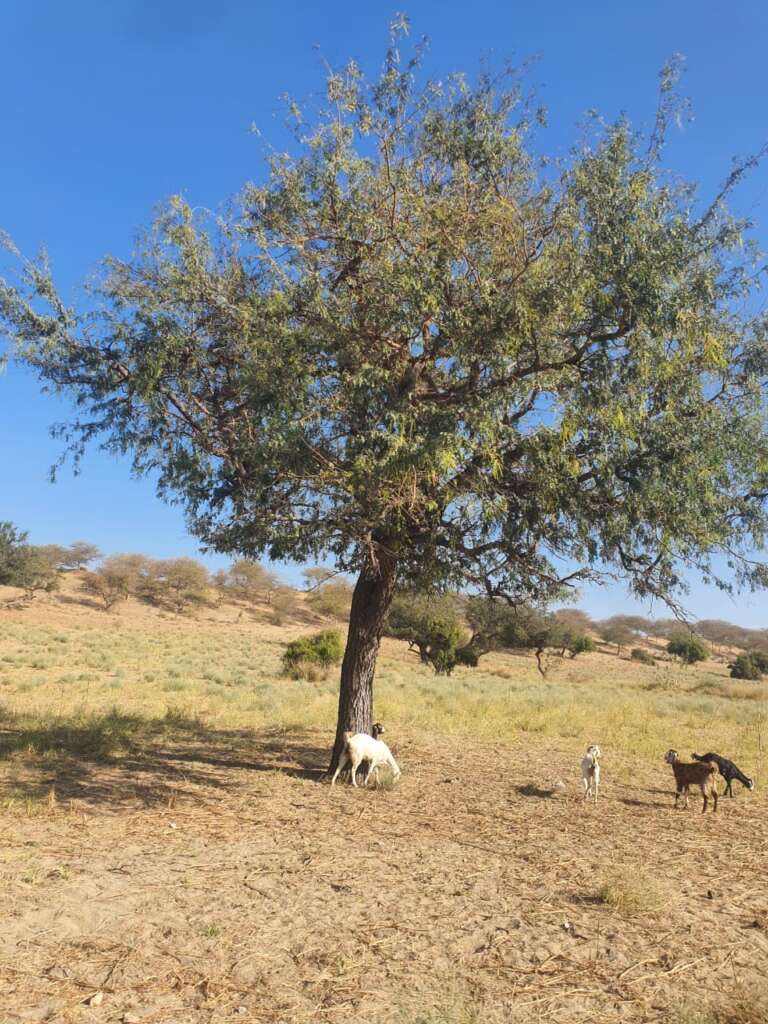
Trees and humans are cousins. They are offspring of the same ancestors. They have coexisted since the first day. As time passed, they became more distinct and distant from each other. As the capitalist system commodified nature, trees were also commodified by the system. Now, human beings don’t see the centuries-old relationship between them, but massacre trees for their own benefit, forgetting their centuries-old blood relation. Amidst this situation, the people of Thar still treat trees like their own family members.
They are very conscious of their plants. As someone said, they keep an axe on their shoulder every time while roaming in the jungle but do not cut trees. They even worship some trees. The Holy Basil plant (Tulsi) is sacred in Hinduism. Hindu people consider Holy Basil auspicious in their homes. It is a religious custom of Hinduism in Thar that people plant Holy Basil, and when it matures, they properly arrange its marriage. Those who first planted the Holy Basil become its parents and marry it to a particular kind of stone known as Shaligram. The marriage happens according to Hindu custom, in which the Holy Basil plant becomes the bride of that stone. They take four rounds around the sacred fire as a marital custom in Hinduism, and then the parents of Holy Basil leave her at the nearby temple with that stone, which is considered the in-laws’ home of Holy Basil.
The Tulsi Vivah is a symbolic ceremonial wedding that signifies the end of the monsoon and the beginning of the wedding season. In this marriage, Holy Basil is personified as Goddess Lakshmi and Shaligram is personified as Lord Vishnu.
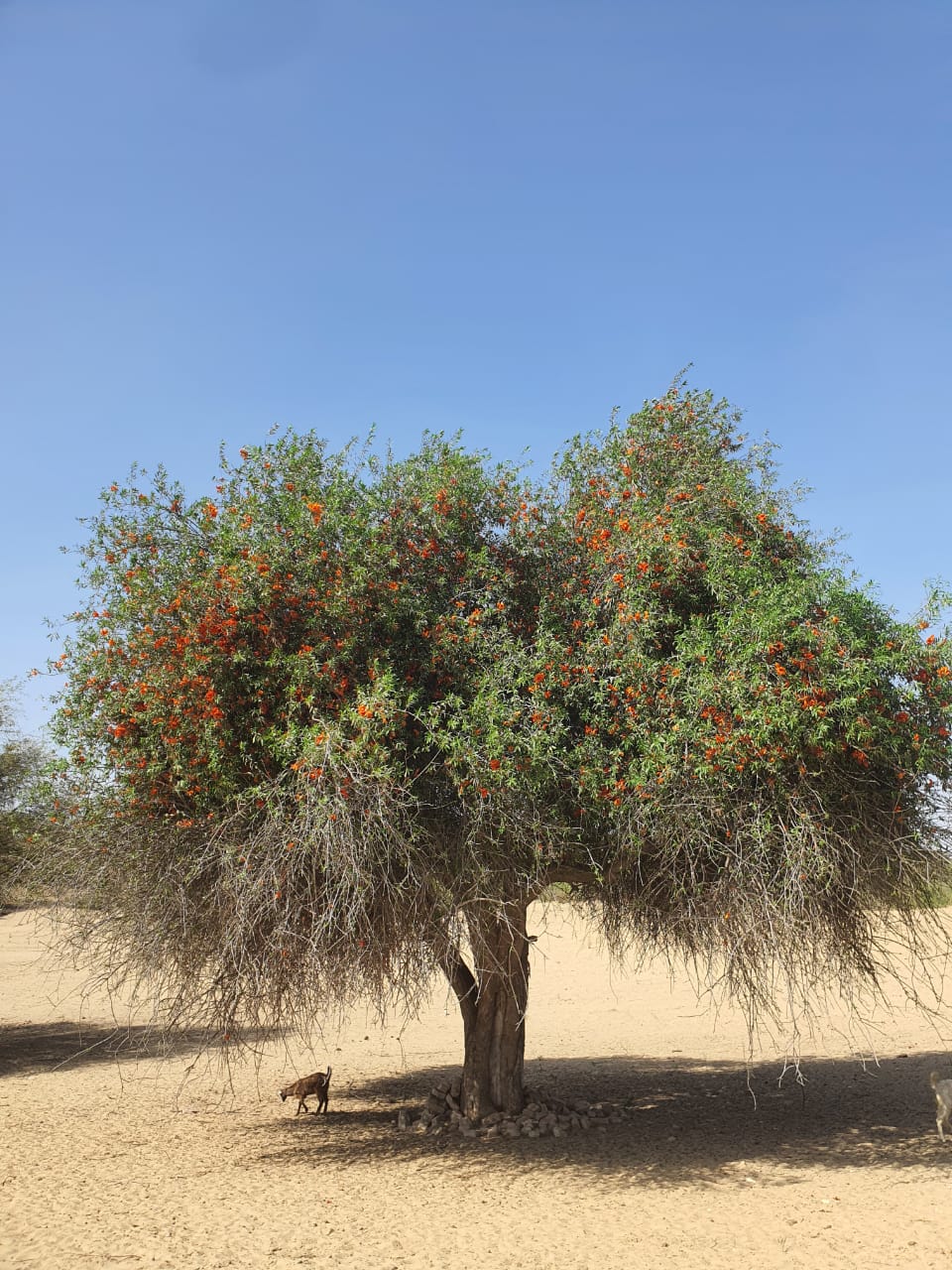
In Thar, where Holy Basil does not naturally grow, Thari people consider the Ghaf tree as Holy Basil. The Ghaf tree is one of the most significant trees in the ecosystem of Thar. Thari people own cattle that eat the leaves of the Ghaf tree as their favorite food. The Ghaf tree grows a vegetable in the spring season known as pods (Sangriyoon), which is a fruit by definition but treated as a vegetable by Thari people when cooked. It is also food for their livestock. When pods ripen, they turn into a sweet fruit. Thari people also preserve unripened pods for future vegetable consumption.
The Ghaf tree is also used in Hindu customs, as it is considered sacred. They burn the sacred fire with the bark of its stem as a ritual in marriage when taking rounds around the fire. They also burn fire with its bark while performing rituals during death and birth. Thari people have even eaten flour made from its bark when there was drought in Thar. Thari people don’t cut branches of the Ghaf tree to serve its leaves to their cattle; instead, they collect its leaves by hand so as not to harm it by cutting. While talking about “Trees and Thar” with Amar Rai Singh, a poet hailing from a remote village of Thar, he recited a poem in Marwari (Thari language):
Khejdi (Ghaf tree)
_Dhan Dhan Thari chaaanv Khejdi
Muradhar maahi thanai sab, sab dhaani-majraan-gaanv khejadi
Kiyaan bakhaanu thaari maaya, dhan-dhan thaari chhaanv khejadi.
Khadi ekli thoon madmaati.
Kair bordi thaara saathi.
Dharaan mein thoon kikar jeevai?
Kinya ret mein khaavai peevai?
Kosaan taai nijar na aavai, jal ro koi thaanv khejadi.
To bhi baarah maas hari thoon, dhan-dhan thaari chhaanv khejadi.
Nit ra olyun-dolyun thaarai.
Kaala hiran kulaancha maarai.
Mor, kamedi, kurjaan bolai.
Godawan ra joda dolai.
Kadai daala pai koyal kookai, karai kaagla kaanv khejadi.
Unt paanada khaa ardaavai, dhan-dhan thaari chhaanv khejadi.
Syaalo ar unyaalo jhelai.
Aandhi ar dugat soon khelai.
Loo ri laptan laava levai.
Pan thoon uf tak neen bolai.
Mhaan logaan ra joota jak mein, daajhan laagai paanv khejadi.
Panthi ruk visraam karai hai, dhan-dhan thaari chhaanv khejadi.
Teej tinvaaran maanda mokai.
Kanai bani pathvaari dhokai.
Beend-beendni Bhairun poojai.
Meetha geet badhaava goonjai.
Kadai lugaayaan katha padhai hai, thaaro ajab subhaav khejadi.
Surataru maan thanai poojai hai, dhan-dhan thaari chhaanv khejadi._
English Translation
In the land of Marwar, you nurture all — every hamlet, every settlement, every village, O Khejri (Ghaf tree).
How can I describe your grace? Blessed, blessed is your shade, O Khejri.
You stand alone, intoxicated with pride.
Kair and Bordi are your companions.
How do you live in the sand dunes?
How do you eat and drink in the desert?
For miles there is no sign of water, no source of water, O Khejri.
Yet you stay green all twelve months. Blessed, blessed is your shade, O Khejri.
Visitors crowd around you every day.
Blackbucks leap and play near you.
Peacocks, doves, and cranes call out.
Pairs of Great Indian Bustards roam.
Sometimes a cuckoo sings from your branches, and crows caw, O Khejri.
Camels chew your leaves and bellow. Blessed, blessed is your shade, O Khejri.
You endure winter and summer.
You play with storms and sand swirls.
You take the blazing flames of the loo winds.
Yet you do not utter even an “uf” of complaint.
When our people’s feet burn inside their shoes, O Khejri,
Travelers stop and rest. Blessed, blessed is your shade, O Khejri.
On Teej and festivals, on happy occasions,
A small shrine is built beside you and worshipped.
Bride and groom pray to Bhairu under you.
Sweet songs of celebration echo.
Sometimes women recite your stories — your nature is wondrous, O Khejri.
They revere you as the divine Surataru tree. Blessed, blessed is your shade, O Khejri.
This poem was composed by the famous Rajasthani poet Girdhar Raghu and is included in the Rajasthan education board curriculum. In this poem, the poet highlights the virtues of the Ghaf tree for the people of Marwar (the Indian side of the Thar Desert). He explains that, while tackling all difficulties, this beautiful Khejdi provides cool shade to the animals and humans of Marwar, and for this, the Khejdi deserves appreciation.
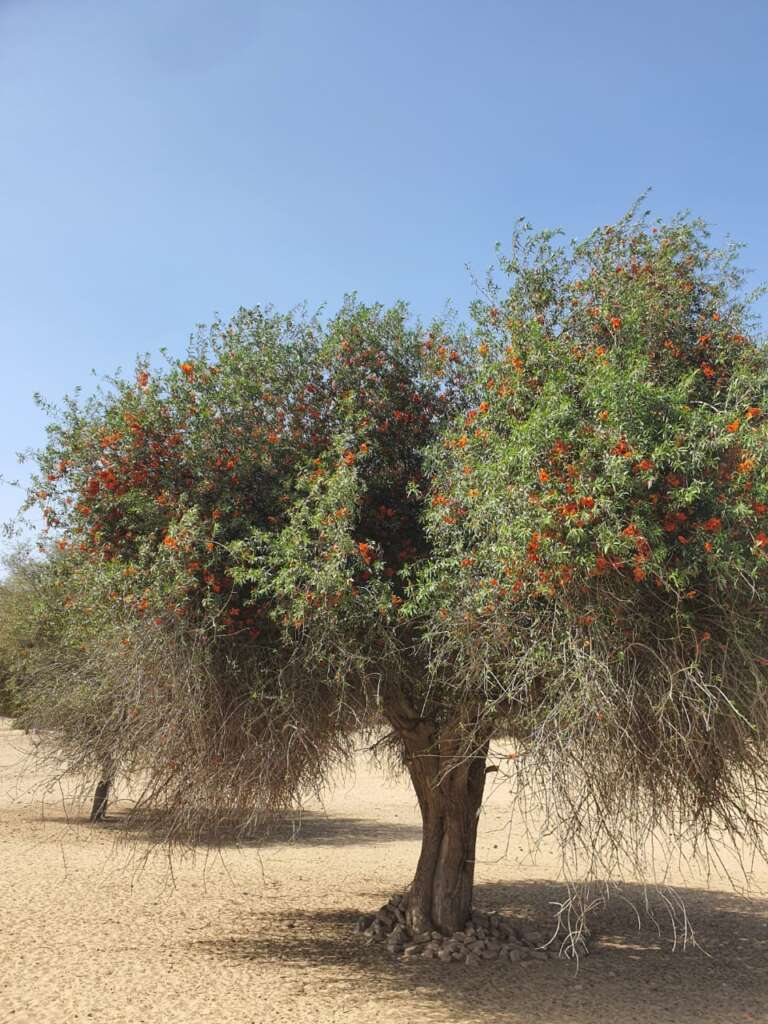
One of the most beautiful trees that holds a particular place in Thar is the Desert Teak (Tecomella undulata), which is considered sacred. A particular community in Thar doesn’t use its wood for burning or making any wooden articles, nor do they use it for making their huts. They respect this tree because the idol of Goddess Malhan is made from Desert Teak, so they don’t cut this tree out of spiritual attachment.
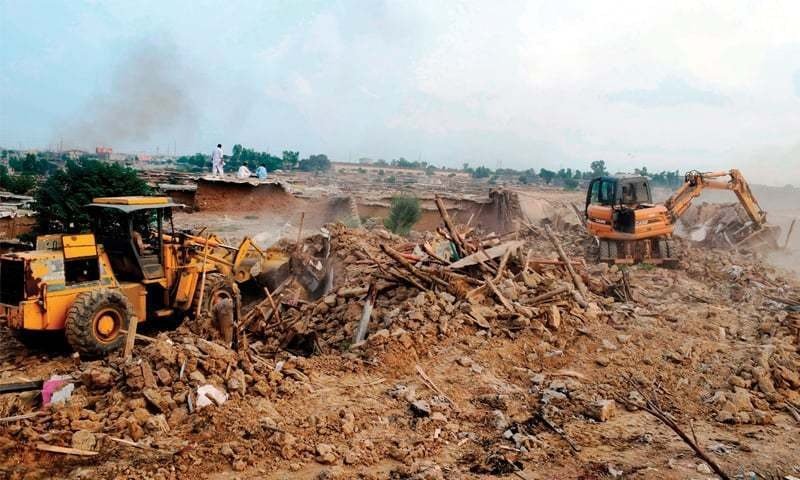
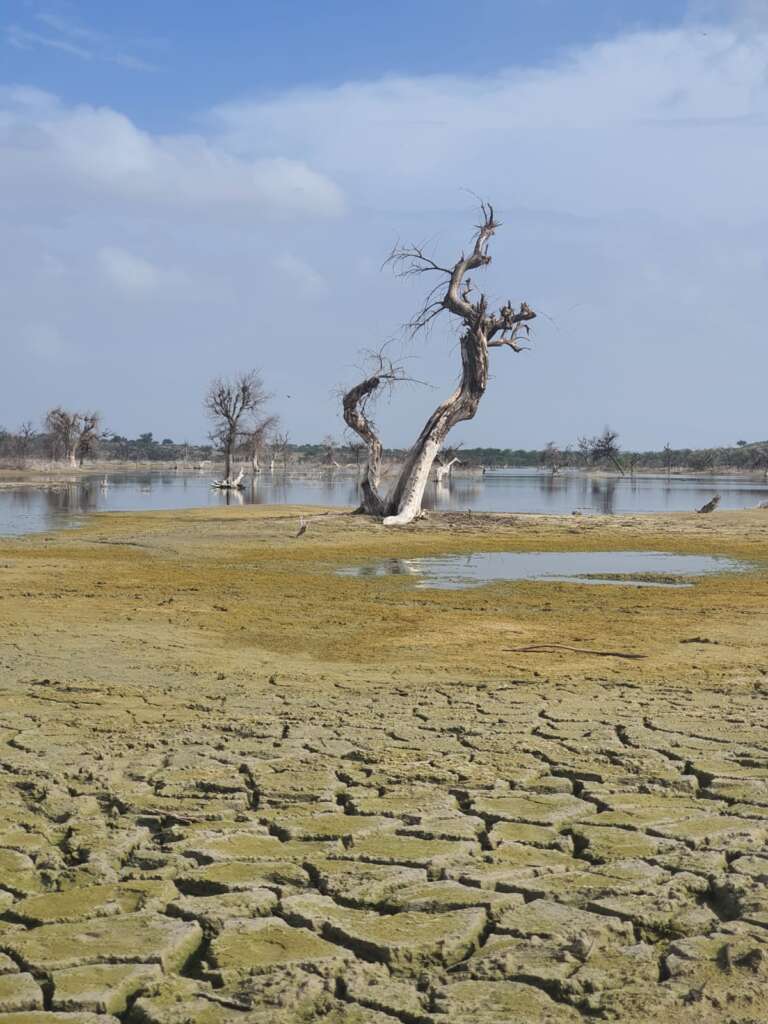
Sitting at Cafe Thar on Mithi bypass with Akash Hamirani, holding bowls of tea made with goat’s milk, we were thinking about the relationship between trees and Thari people and the recent rift in that relationship. Akash told me that Thar has paid a human cost for Thar coal mining, which is reported and highlighted everywhere, but the plant cost of Thar coal mining goes unreported and silent. Because trees can’t speak, they can’t protest in front of the press club, so people don’t notice their massacre. Thar coal mining projects have massacred a very large number of trees. After taking a sip of fresh tea, he further said that the overall coal project has two blocks: Block 1 covers 25,000 sq. km and Block 2 covers 30,000 sq. km. There is a dam known as Gorano, built on 1,500 acres for dumping the wastewater extracted from mining in Block 1 and Block 2. They are also constructing a railway track from New Chhor to Block 1 and Block 2. They are also working on a pipeline to supply fresh water to the staff of both blocks. Here he finished his tea, lit a cigarette, and continued his talk: this coal mining project, the dam for dumping wastewater, the railway track, and the water pipeline have led to the cutting of trees in the lakhs. Trees like Desert Teak, Ghaf, Mustard, Jujube, Neem, and so on, some more than two hundred years old, have been ruthlessly killed to make this project successful. Other bushes have also been cut in large numbers to pave the way for this project. The exact number of trees is still unknown, but the cutting has happened on a major scale. This much massive deforestation has not happened before in the history of Thar.
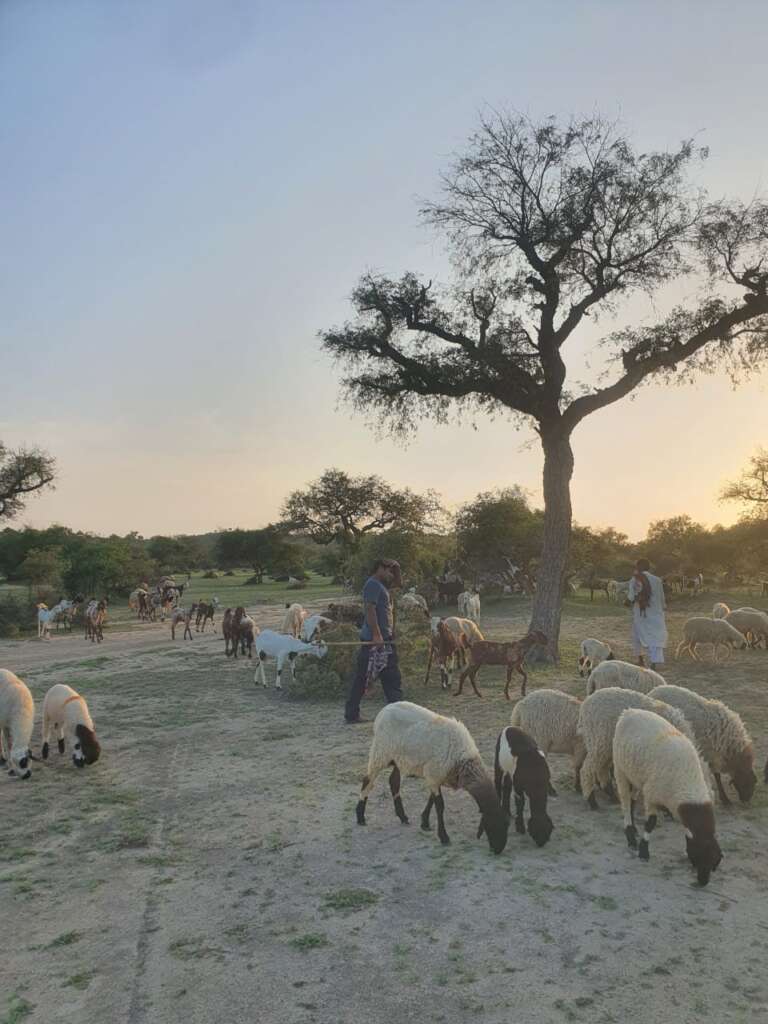
Thari people use wood for burning only from trees that were dead; they do not cut any green tree to collect wood for burning. After a silence of a few moments, he took a deep sigh and said that one Ghaf tree feeds approximately 100 goats per year, and approximately 15,000 to 20,000 Ghaf trees have been destroyed in Gorano Dam. He further said in an emotional tone that Thar’s trees were safe when Thar’s land was owned by Thari people. They had a proper community-led system in every village for the safety of trees and animals. He added that he remembers that once he cut a very small branch of a Mustard tree in his village during his childhood, and his grandfather scolded him and told him not to cut a green tree. Our people take care of trees not just because they are a source of food for them and their cattle, but because they have a kind of emotional attachment to the trees. Trees hold a very particular place in the existence of Thari people. Without trees, they can’t imagine their homeland, their geography, their villages, their cattle, their farms, or their meadows.
The tree is the reference point in the imagination of Thari people. They can’t think without considering the tree. They can’t talk without giving a reference to the tree. The mapping of their villages and farms is demarcated with references to trees. The boundary of one village is considered separate from the boundary of another village with reference to a tree. Their farms are demarcated by using a line of trees that keeps them separate. Particular places in meadows for cattle grazing are named after trees. Villages are named after trees. Farms are named after trees. Routes connecting villages are named after trees. Wells are named after trees. Trees hold a very particular place in the mind of Thari people.
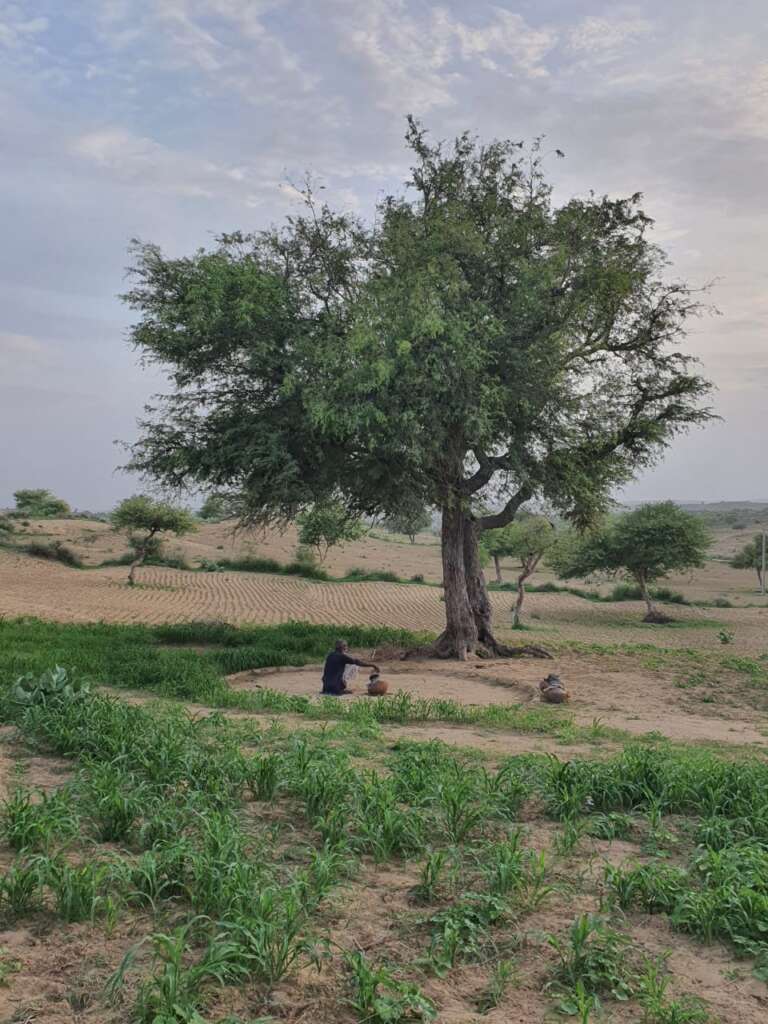
People who died or migrated to India a long ago are remembered after the trees they planted. So trees contain memories and ancient history with them. They consider the tree a living being. They don’t cut any of its branches after sunset because they think that night is the resting time of the tree, so cutting at that time is a betrayal that harms it more. If they need a branch of a tree urgently after sunset, they put some quantity of grain at the roots of the tree, take permission from the tree, and then cut that particular branch. Whenever anybody needs wood for making furniture, they first try to find a dry tree to cut, as if it can’t feel any kind of pain.
A friend of mine went to a carpenter to order a fancy wooden door for his house. The carpenter asked him to first find a dry tree for wood. He found a dry tree and asked the carpenter to cut it and take it to his shop to make the doors. The carpenter replied that he does not cut standing trees, whether they are dry or green. He uses cut wood to make articles; he does not cut trees himself. So, my friend had to find someone else to cut the standing tree and then give the timber to the carpenter to make the doors.
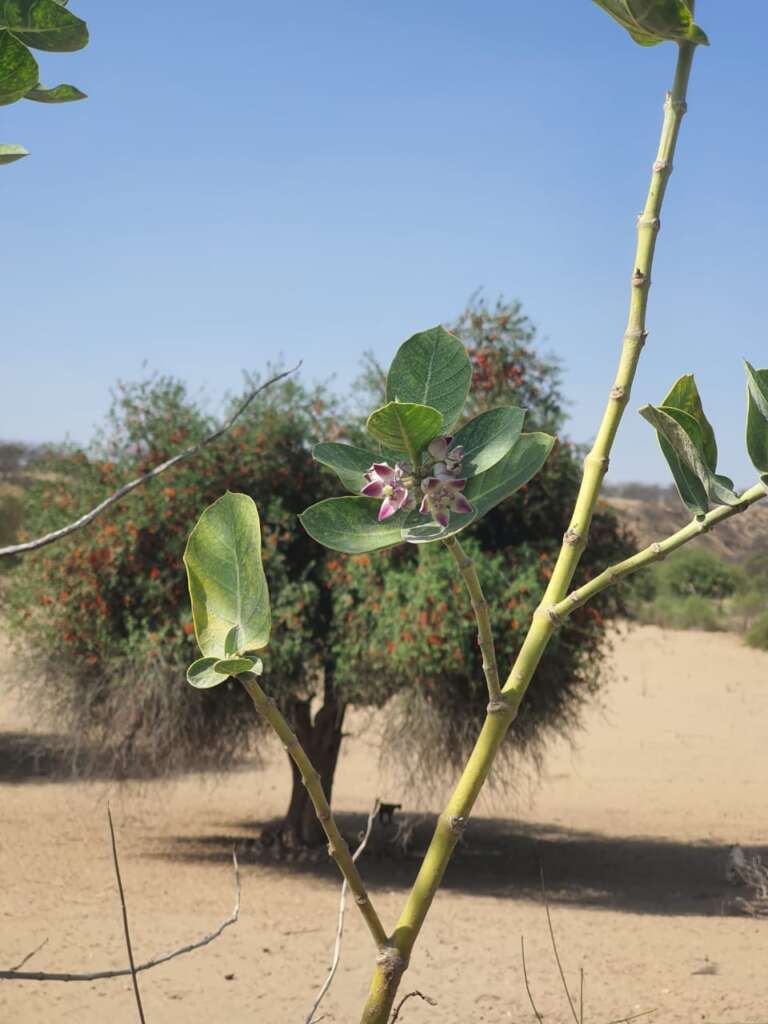
Thari people do not value trees only when they are alive but also give them importance in the afterlife. A grave under a tree is considered good because the dead person is resting under the cool shade of the tree. If any green plant grows on someone’s grave, it is considered a sign that the person has gone to heaven. Thari people consider trees equally important in this life and the hereafter, it is a relation that we all need to learn from.