From Cold War montage to contemporary capture, on the persistence of imperial form.
Why intervention no longer argues its case, but edits it.
“Nothing is lost if one has the courage to proclaim that all is lost and we must begin again.”
— Julio Cortázar. Around the Day in Eighty Worlds.
Translated by Thomas Christensen. San Francisco: North Point Press, 1986.
Some political truths resist exposition. They refuse the patient architectures of argument and the measured progressions of evidence. They do not clarify when handled carefully. Instead, they worsen, intensifying like a fever that spreads—overheated, recursive, metabolised too quickly to be stabilised. This is not because the facts are inaccessible, nor because reality has slipped beyond documentation, but because the grammar tasked with conveying them has been overworked, bent into service, and quietly corrupted by repetition. When language has been trained to justify force, explanation itself becomes suspect.
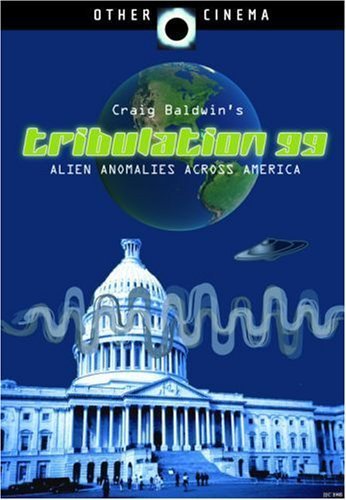
Tribulation 99: Alien Anomalies Under America, Craig Baldwin’s forty-eight-minute “pseudo-pseudo-documentary,” explores corruption with unnerving clarity. The film isn’t a parody or replacement of history. Instead, it examines the construction and operation of stories. Baldwin amplifies the narrative mechanics, making political violence seem rational, pushing them until they collapse. U.S. intervention in Latin America becomes a delirious cosmology of subterranean aliens, radioactive test sites, and secret agencies beneath the continent. This doesn’t ridicule the intervention, but reveals how easily delirium becomes explanation when doubt and real analysis are missing.
Tribulation 99 understands a key fact: modern imperial actions rarely arrive in plain sight. They are always captioned, narrated into coherence, so the violence comes pre-explained. These events are protected from question by the force of their own stories. Baldwin stages this as excess. He doesn’t argue against imperial reason, but overwhelms it with itself.
More than three decades after the film’s release, fever returned not as a metaphor but as a political condition. On 3rd January 2026, the Trump administration authorised a covert military operation on Venezuelan soil that resulted in the capture of Nicolás Maduro and his immediate transfer to New York. The act was swift, unilateral, and deliberately spectacular. Yet what mattered as much as the operation itself was its framing. It was described not as an invasion or an act of war, but as “law enforcement” conducted with military support. Indictments were produced. The language of necessity was deployed. The event was already complete, packaged as an explanation rather than a question.
What followed was not a single global response but a proliferation of story-machines: Illegal aggression, kidnapping, liberation, hemispheric stabilisation, narcoterrorism, an oil reset, and a cartel war escalated. The disagreement was not only over what had occurred, but over which narrative physics would govern what could be said to have occurred at all. Each account carried its own assumptions about sovereignty, legality, urgency, and jurisdiction. Each sought to pre-empt the others by accelerating faster, by explaining more decisively.
At this point, Tribulation 99 ceases to function as a cult artefact and becomes a diagnostic instrument. Baldwin did not predict the Venezuelan raid in any literal sense. What he anticipated was something more revealing: the way imperial action increasingly arrives already formatted as intelligibility, its violence converted into explanation by the speed and coherence of its narration. In Baldwin’s fictional universe, unrest is attributed to ancient extraterrestrial forces buried beneath nuclear test sites. In the present, unrest is attributed to narcoterrorism, failed states, cartel networks, energy insecurity, and the ever-ready insistence that history has become too dangerous to be left to law. The lexicon shifts. The scaffolding of justification remains intact.
Montage as Imperial Syntax
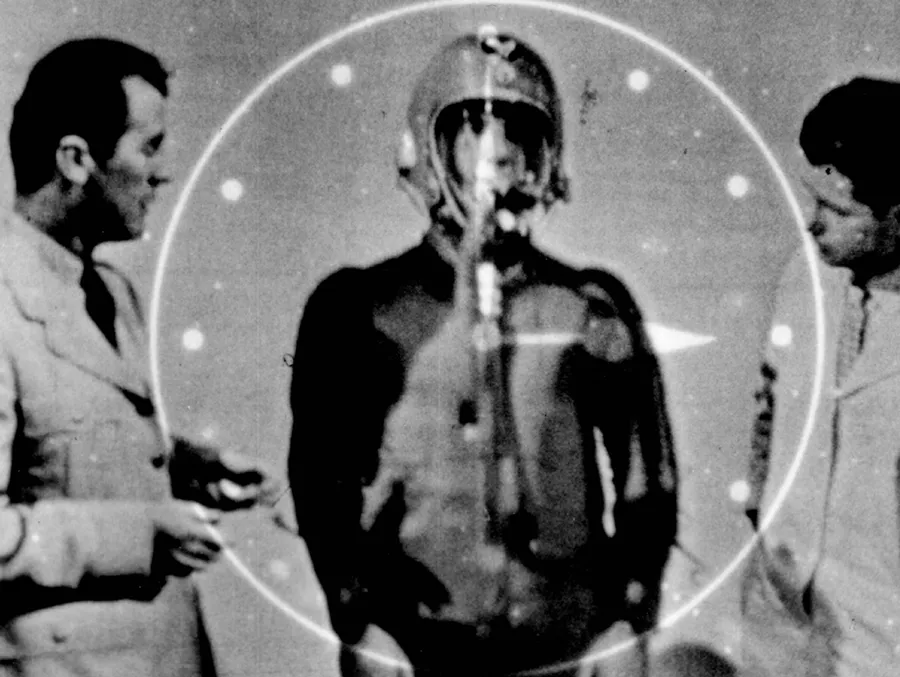
Tribulation 99 is built entirely from scavenged images. Cold War newsreels, educational shorts, B-grade science fiction, propaganda films, military training footage, procedural diagrams. Nothing is original; everything is repurposed. The montage is breathless, accusatory, relentless. The voiceover does not interpret or qualify. It insists. It connects. It accelerates. The narrator speaks with the manic confidence of someone who has mistaken pattern-making for truth.
This film is not a comfortable parody. Baldwin doesn’t let viewers stand outside paranoia and laugh. Instead, he makes them experience paranoia as an explanation. The film doesn’t just show conspiratorial thinking; it performs it. By doing this, it makes paranoia look like a central American habit: a hunger for total explanation, a refusal of uncertainty, and a drive to turn chaos into story.
Conspiracy theory is not the opposite of imperial reasoning but its close relation. The empire trusts institutions for authority; conspiracy trusts intensity. Both seek mastery through connection and offer coherence where complexity could remain. Their key difference is not in how they work, but who approves them.
Baldwin’s subterranean aliens, the Quetzals, are less a plot device than a conceptual solvent. They dissolve the viewer’s confidence that official history is always more rational than fringe cosmology. Because Baldwin’s thesis is not that conspiracies are true. It is that the conspiracy form is a parody of imperial reason, and that imperial reason often behaves like conspiracy form. Connect the dots. Skip the proof. Narrate coherence. End with force.
Here Baldwin converges, unexpectedly but precisely, with Walter Benjamin. In his “Theses on the Philosophy of History,” Benjamin warns that historical narration is written from the vantage of the victors, and that catastrophe habitually appears disguised as progress. Tribulation 99 renders this warning perceptible. History emerges not as a linear record but as debris propelled forward by a storm called reason—a force that drives events while scattering their meaning. The Quetzals function as grotesque proxies for this storm. They are not causes. They are excuses. Their role is to allow violence to masquerade as destiny.
Benjamin’s insistence that “even the dead will not be safe from the enemy if he wins” finds material form in Baldwin’s archive. Old footage is exhumed, repurposed, drafted into new conflicts. The past is not recalled so much as redeployed. Archives become contested terrain. Memory itself becomes a weapon.
The film’s aesthetic excess is therefore not ornamental. The flashing graphics, crude effects, and hyperventilated pace reproduce the sensation of being carried by an argument that never pauses long enough to be audited. The viewer is not invited to evaluate. The viewer is invited to submit. And once submission becomes audible as rhythm, it begins to echo beyond the film, into other domains of political life.
If Benjamin supplies Baldwin with historical gravity, Guy Debord supplies his political horizon. Tribulation 99 unfolds entirely within the conditions Debord described as the society of the spectacle: a world in which representation (images and symbols substituting for direct experience) displaces experience and politics reorganises itself as image circulation. The stock images Baldwin deploys—mushroom clouds, suited intelligence officers, generals gesturing at maps—do not function as evidence. They function as symbols. They enact what Debord understood not as deception but as a social relation mediated by images (meaning, relationships between people shaped by shared imagery).
Intervention becomes something to watch rather than something endured. Violence becomes legible only when rendered cinematic. The January 2026 raid unfolded in precisely this register. Blindfolded photographs. Courtroom sketches. Aerial footage of naval deployments. Statements calibrated for broadcast. These images did not merely record the event; they structured it. What mattered was not only what happened, but how it appeared.
Debord insisted that spectacle does not hide reality; it supplants it. Baldwin presses further. Spectacle becomes the only idiom through which power can now speak. An intervention must resemble a series, a mission, or a narrative arc. Even sovereignty must be formatted as content.
Jurisdiction Without Geography
What distinguished the Venezuelan operation was not only its violence but its costume—the outward appearance it adopted. The seizure of Nicolás Maduro was described as a law-enforcement action, a prosecutorial action conducted at scale. This was not a metaphor. It was a jurisdictional claim. War did not announce itself as war. It appeared instead in the language of arrest, indictment, and transfer, as though sovereignty were merely a procedural obstacle awaiting override.
This manoeuvre did more than evade diplomatic convention. It attempted to redraw the space in which judgment itself occurs. By translating a military incursion into prosecutorial logic, the United States displaced the terms under which the action could be assessed. International law was rendered secondary to domestic criminal procedure. The question was no longer whether force was permissible between states, but whether sufficient cause existed to remove an individual from circulation. The state dissolved into a suspect.
Here, the operation revealed its longer ambition. It was not only Maduro who was seized, but Venezuela’s claim to jurisdiction over itself. The country was temporarily transformed into a zone of extraction: bodies, authority, legitimacy. The flight to New York was the symbolic completion of this process. Sovereignty did not end. It was relocated.
This logic has precedents, though they are usually described in softer terms. Police actions conducted abroad. Special renditions. Targeted killings recoded as security measures. What marked January 2026 was the brazenness with which the translation was performed. The fiction of continuity between policing and warfare was no longer implied. It was declared.
The political effect was immediate. Once violence is redescribed as administration, it ceases to require justification in the old sense. One does not debate whether a warrant should exist; one debates whether procedure was followed. The ethical question is displaced by a technical one. Baldwin understood this displacement intuitively. His extraterrestrial CIA is absurd, but the absurdity clarifies the move: when authority invents a new jurisdiction, it does not argue for it. It acts as though it were already in place.
Permission, Archive, Afterlife
This is the point at which Baldwin’s montage intersects with the work of Ariella Azoulay. Azoulay’s writing on imperial regimes of permission insists that violence does not merely occur and then receive legal cover. Rather, legality is retroactively manufactured through images, archives, and documentation practices that stabilise power after the fact. The archive is not memory; it is governance.
Seen through this lens, the Venezuelan operation did not end with Maduro’s extraction. It continued through its documentation. Press briefings, courtroom filings, diplomatic communiqués, oil-sector projections. Each artefact performed a quiet labour of authorization. The event was folded into a bureaucratic record that treated its own premises as settled.
Azoulay’s crucial insight is that under imperial conditions, not all lives are equally archived. Some are preserved as evidence; others are processed as data. Baldwin’s Latin America exists squarely in this second category. It appears not as history but as inventory. A region of operations rather than narration. What happens there is not remembered so much as managed.
This distinction clarifies why outrage alone failed to gain traction. Venezuela’s interim leadership condemned the operation as illegal aggression while signalling openness to negotiation. This double register was not hypocrisy. It was compulsion. To speak only in the language of law would be to risk irrelevance. To speak only in the language of survival would be to concede legitimacy. Empire forces its targets to speak bilingually, under conditions not of their choosing.
Baldwin compresses this predicament into sensation. His archive is stripped of hierarchy. Everything circulates at the same pitch. Nothing settles long enough to acquire authority. The result is not relativism, but exposure. One sees how easily authority is conferred by repetition, how quickly documentation slides into justification.
Speed as Weapon
Where Azoulay attends to the archive, Virilio attends to velocity. Virilio argued that modern power is organised around acceleration. Speed does not merely enable action; it disarms response. The faster an event unfolds, the fewer opportunities exist to contest its premises. Velocity functions as camouflage.
Tribulation 99 is built on this insight. Images arrive faster than they can be processed. Claims outrun skepticism. The viewer is propelled forward, disoriented, unable to stabilise judgment. This is not aesthetic excess for its own sake. It is pedagogy. Baldwin teaches by overwhelming.
The Venezuelan raid followed the same logic. Execution was rapid. Messaging immediate. Interpretation arrived pre-installed. By the time dissent assembled itself, the event had already been metabolised into routine: diplomatic talks, market speculation, security reassurances. Speed converted contingency into facticity.
Virilio warned that every system produces its own accident. Baldwin sharpens the warning. Imperial violence is not the accident of modern governance. It is its most efficient expression. The faster the act, the less accountable it becomes. The less accountable it becomes, the more readily it can be repeated.
Resource, Rehearsal, Continuity
Baldwin’s title insists on geography. Alien Anomalies Under America. The word “under” names not only a location but a relation. Beneath protection, beneath concern, and left to law only in name. In the film, this underworld is populated by aliens. In reality, it is populated by extractive economies, inherited debt, militarised politics, and the long afterlife of intervention.
The January 2026 operation revived this cartography intact. Venezuela reappeared not as a polity but as a malfunction. A problem to be solved. A resource to be restructured. Statements about oil production and future management surfaced almost immediately, not as policy proposals but as assumptions. The hemisphere once again resembled a workshop. The United States, once again, is its foreman.
This continuity is not ideological. It is procedural. What persists is not a belief but a technique. If sovereignty obstructs access, it is reclassified. First, as illegitimate. Then, as a criminal. Then as dangerous. Finally, as an administrative. Each step requires a caption. Each caption reduces resistance.
Baldwin stages this reduction mercilessly. His aliens never disappear. They must remain underground to justify perpetual operation. Today’s spectres perform the same labour. Cartels. Migration. Instability. The threat is never meant to be resolved. It must endure in order to rationalise presence.
Knowing Otherwise
Baldwin’s final provocation is epistemic. He asks not what happened, but what kind of knowing is being solicited. Are we being invited to judge, or to comply? Are we meant to understand, or to accept?
Knowledge without interruption collapses into information. Information without friction collapses into authority. Baldwin refuses this collapse by making the explanation unbearable. His delirium is not confusion. It is resistance.
Tribulation 99 does not offer an alternative account of history. It offers a lesson in hearing. Once the cadence of imperial narration becomes audible, its force weakens. One begins to notice how arguments arrive already concluded, how urgency substitutes for proof, how violence is smuggled in as inevitability.
The Venezuelan episode will be archived, debated, and normalised. That process is already underway. Baldwin does not teach us how to stop it. He teaches us how not to mistake its smoothness for truth.
The fever, once recognised, ceases to be pathology. It becomes a method.