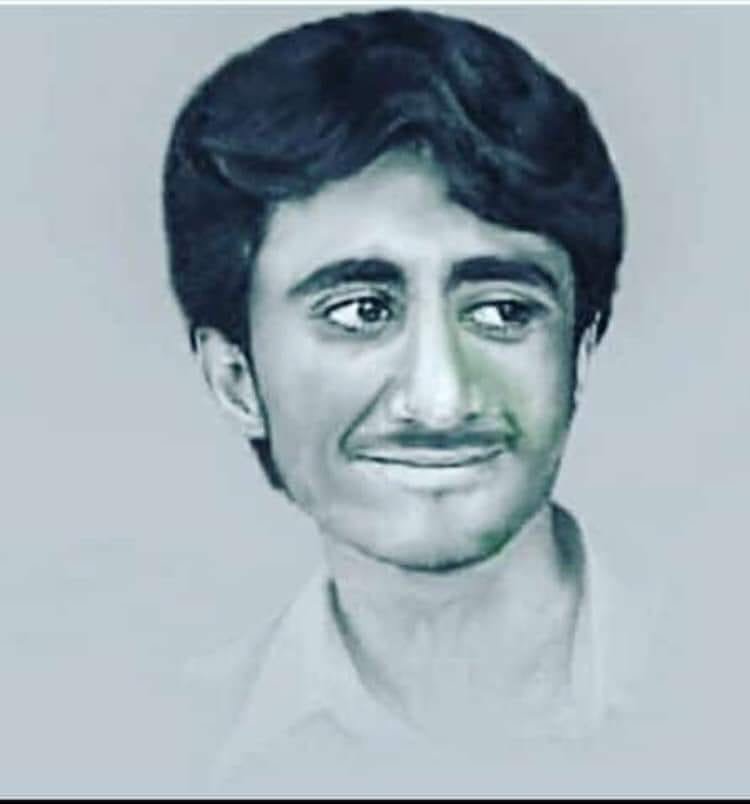
“Even today, in difficult times, the movement’s ability to stand firm owes much to martyrs like Kamber Chakar. Without their ultimate sacrifice, future generations would not inherit such a strong spirit of resistance.”
—Darapshaan Baloch, former chairman, Baloch Students Organization (Azad), 2024
Kamber Chakar (1987–2011) remains one of the most iconic figures in Balochistan’s struggle for freedom. A student leader, poet, and revolutionary, Chakar’s life embodied the principles of sacrifice, courage, and unwavering commitment to the Baloch cause. According to Darapshaan Baloch, “Kamber personified revolution—he was a revolution in himself. His commitment and willingness to sacrifice continue to inspire thousands of young people to this day.”
Early Life and Student Politics
Kamber Chakar joined the Baloch Students Organization–Azad (BSO-Azad) in the early 2000s, quickly becoming a dedicated member. He was elected college unit secretary in 2005, deputy organizer of the Turbat zone the same year, and later deputy organizer of the Quetta zone in 2008. His leadership abilities earned him a place on the BSO-Azad central committee just two days after his release from prison on April 22, 2010.
Chakar’s first abduction occurred on July 5, 2009, allegedly for carrying a hand grenade with friends. Eyewitnesses claim the evidence was planted by security forces. During this period, Balochistan’s political environment was extremely dangerous, with abductions and extrajudicial killings common. Shahzaib Baloch, a contemporary activist, recalls protests organized by Kamber and the Quetta zone cabinet against such illegal detentions, during which “Kamber’s speeches roared through the streets, inspiring resilience among students and activists alike.”
Political Activism Amid Repression
The post-2000 phase of the Baloch national struggle faced heightened state suppression, including military operations, enforced disappearances, and the infamous “kill and dump” policy. Prominent leaders such as Ghulam Mohammad Baloch, Lala Muneer, and Sher Mohammad Baloch were abducted and later found mutilated, underscoring the perilous environment in which Kamber and his peers operated.
Despite these risks, Kamber remained steadfast. As Saeed Shad, his relative, notes, “During his tenure as deputy organizer of the Turbat zone, fourteen members were abducted, yet Kamber fulfilled his responsibilities with commitment. When asked about the worsening political climate, he resolutely said: ‘This is the revolution; freedom cannot be achieved through mere songs and dances.’”
Kamber played a crucial role in student-led campaigns such as the 2008 quota system struggle organized by the Baloch Students Action Committee (BSAC). Alongside colleagues, he participated in hunger strikes and rallies, demonstrating exceptional discipline and organizational skill. Shahzaib Baloch recalls: “Kamber became increasingly effective, vigilant, and shrewd in mobilizing Baloch students, particularly at BUITEMS.”
Ideology and Devotion to Martyrdom
Kamber Chakar’s writings and speeches reflect his profound dedication to Baloch independence. He embraced the philosophy that revolutionaries may choose death, but they never truly die—they live on in the struggle. In his article Kamber Kay Tahi Obalaa’n Pad Bejanth Gaaren (“Who May Pursue Your Lost Dream”), he quotes José Martí: “Death is nothing but life; dying means being a seed. The one who dies where he has to shall live forever.”
He consistently highlighted the path of martyrdom as integral to the liberation movement, referencing figures like Shaheed Ghulam Mohammad Baloch. In his Urdu article Nauabadiyathi Nafsiyath (“Colonial Psychology”), Kamber analyzed how colonial societies maintain control through force, praising armed resistance in East Timor as a model for oppressed peoples.
Kamber’s speeches often intertwined poetry and politics. During a protest following the martyrdom of Ghulam Mohammad Baloch and companions, he recited lines from Atta Shad, capturing the essence of courage in the face of death:
“If you wish me dead, first crush my spirit… But I will not die in death—I am love. I cannot be subdued. Till the end of time, my footprints will remain.”
Abductions and Ultimate Sacrifice
Kamber Chakar was abducted a second time on November 26, 2010, along with his cousin Irshad Nasir. He was released six months later, only to be found dead on January 5, 2011, in the Murgaap area of Kech, alongside Ilyas Nizar, a young journalist and BSO-Azad member abducted in December 2010.
Though his life was cut short, Kamber’s ideals continue to inspire Baloch youth and activists. As Darapshaan Baloch emphasizes, “Young individuals like Kamber Chakar are the essence of our struggle. Their commitment, courage, and sacrifice guide us in the fight against tyranny.”
Legacy
Kamber Chakar’s life stands as a testament to the power of conviction and the enduring impact of sacrifice. He remains a symbol of resistance, a teacher to future generations, and a reminder that true freedom often comes at the highest cost. Through his writings, speeches, and actions, he achieved what few can: immortality in the collective memory of a nation striving for independence.